
Small Apartment Storage Ideas
How to Store a Guitar in a Small Apartment With Limited Floor Space
Choose the storage state before the hardware: protect the instrument’s climate needs, decide how quickly it should be accessible, then spend the least valuable resource—floor area, wall capacity, or case/closet volume—without creating an unsafe mount or a frustrating daily routine.
In This Guide
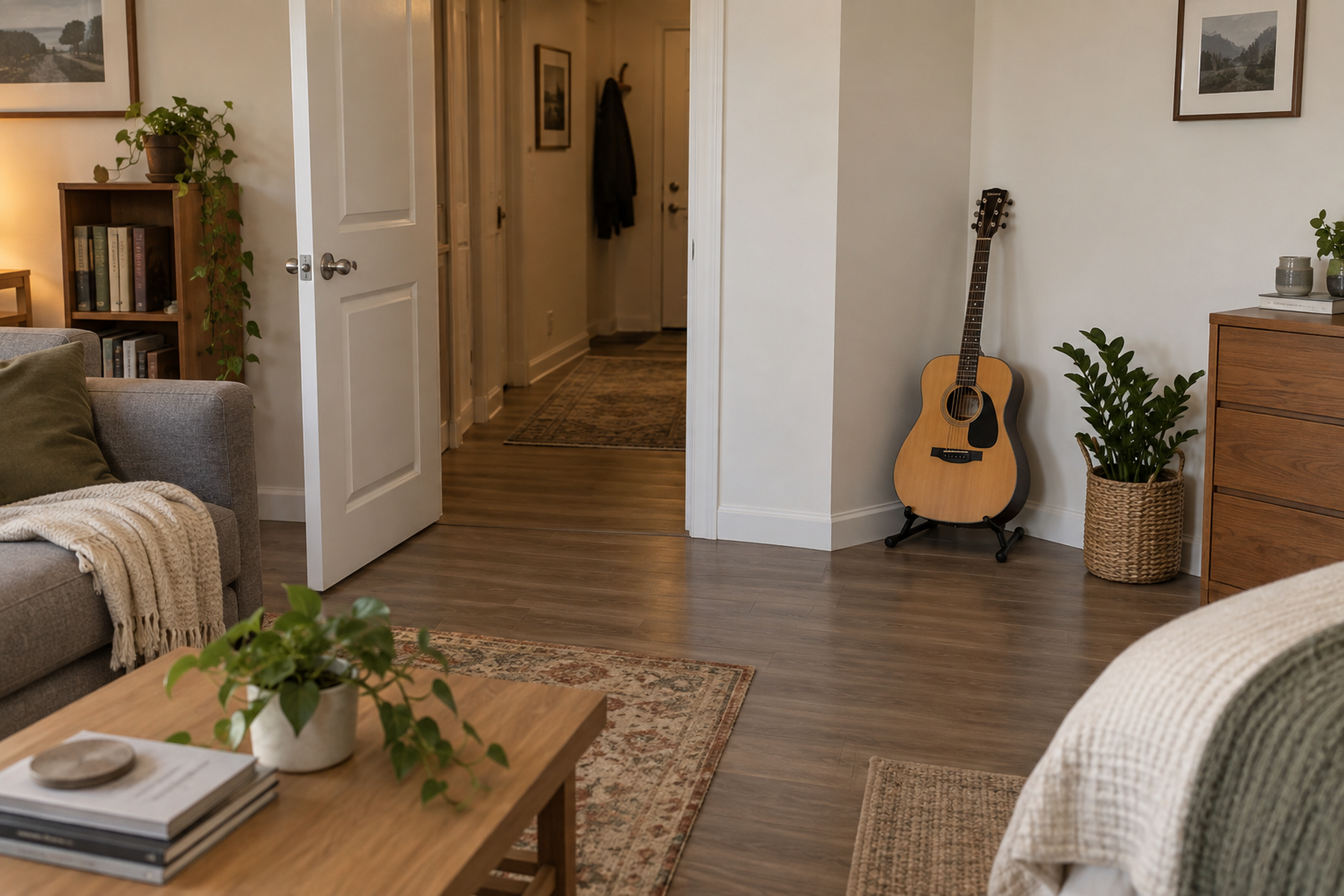
A guitar is not ordinary wall decor. In a small apartment, the instrument may compete for the same floor and wall space as everyday furniture, while acoustic instruments can also be sensitive to humidity, heat, direct sun, vents, and rapid environmental change.
Treat guitar storage as a protection-and-access decision first. The right system gives the instrument enough environmental and physical protection, keeps the apartment circulation clear, and makes the guitar easy enough to retrieve that the storage method still fits how often it is actually played.
Quick Answer
Choose the Storage State Before the Stand or Hanger
Start with play frequency and instrument sensitivity, then decide which apartment resource can absorb the guitar most safely. Case volume, floor area, and wall capacity are three different costs—not interchangeable versions of the same storage idea.
01
Protect climate-sensitive instruments before optimizing display
Taylor and Martin both publish humidity guidance around 45–55% RH for their acoustic instruments. Follow the exact guitar manufacturer first, and reject display locations exposed to heat, vents, strong sun, or unstable exterior-wall conditions.
02
Give daily-use guitars the shortest safe retrieval path
A compact floor stand or verified wall hanger can make sense for an instrument played often, but the full guitar-plus-stand or guitar-plus-wall projection still has to stay outside doors, walking paths, children, pets, and furniture conflicts.
03
Use the case when protection is worth more than instant access
A hard case consumes closet or floor volume, but it also adds impact, dust, and environmental protection. When the wall or room conditions are uncertain, case storage is a deliberate solution rather than a failed display.
01
Decide How Accessible the Guitar Needs to Be
Start with the instrument’s real use pattern. A guitar played every day has a stronger claim on visible, fast-access storage than one played monthly, kept for sentimental reasons, or brought out only for recording or special occasions.
Daily access can justify a compact stand or wall position because every extra case latch, closet door, and furniture move adds friction. Low-use or high-value instruments can tolerate slower retrieval when the slower state materially improves protection.
Do not force an entire collection into one architecture. One daily electric can live on an accessible stand while a valuable acoustic remains in its case and a rarely used third instrument lives in slower protected storage.
This frequency split is especially important after downsizing. The storage system should preserve the instruments that deserve immediate reach without turning the living room or bedroom into a dense equipment warehouse.
02
Check the Room Climate Before You Choose the Display Wall
For acoustic and other climate-sensitive wood instruments, check environmental suitability before deciding that a wall is free storage. A visually perfect wall can still sit beside a heating vent, receive direct sun, or experience stronger temperature swings than the rest of the room.
Taylor and Martin both currently publish a target range around 45–55% relative humidity for their acoustic instruments. That is strong manufacturer evidence for those guitars, not a universal standard for every instrument construction; the exact manufacturer guidance should remain authoritative.
Martin also advises storing the instrument in its case when not in use and warns against heat sources, air vents, direct sunlight, and exterior-wall winter hanging. Those cautions make climate a hard gate before a display decision.
A case can create a smaller, more controllable micro-environment and reduce rapid environmental exposure. That can outweigh the extra storage volume when the apartment climate is difficult to stabilize.
Measure / Check First
Before choosing a stand, wall hanger, rail, tension system, or case location, test the instrument, support method, room environment, and rental boundary together.
Check Climate, Support Fit, and the Real Storage Envelope First
01
The instrument and environmental requirements
Verify the guitar type, exact manufacturer climate guidance, finish sensitivities, weight, neck or headstock geometry, and whether the proposed location sits near an exterior wall, vent, radiator, direct sun, or another environmental stressor.
02
The full floor or wall envelope
Measure the guitar body and headstock in the stored position, not only the stand or hanger hardware. Protect door swing, walking paths, furniture use, children, pets, and the space needed to lift the instrument on or off the support.
03
The support and rental compatibility
Check the exact stand or hanger rating, contact points, wall construction and installation instructions where applicable, and lease or landlord restrictions. Treat unknown wall structure or unverified no-drill attachment as a stop-and-verify condition.
If the location protects floor space but exposes the guitar to poor climate, uncertain support, or an installation the lease does not allow, it has not solved the storage problem.
03
Use the Case as Primary Storage When Protection Matters More Than Display
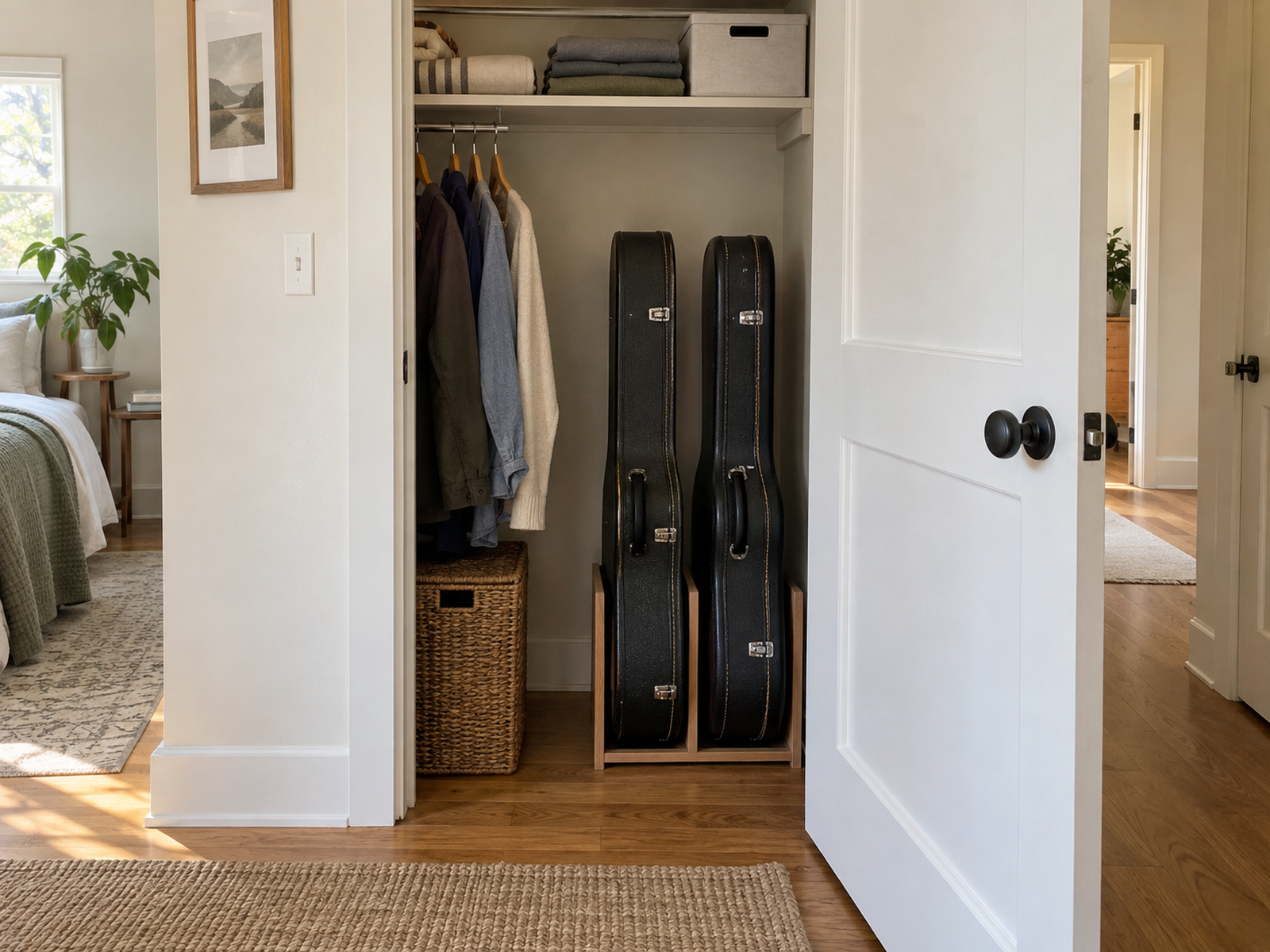
A hard case is the most protection-first storage state in this article. It adds enclosure against accidental contact, dust, and some environmental fluctuation while giving humidity-control products a smaller space to manage when the instrument manufacturer recommends them.
Martin recommends case storage when the instrument is not in use, and Taylor also describes the case as important environmental protection. Fender likewise recognizes case storage as a valid everyday option rather than only a travel state.
Cases still need an apartment plan. Store them where they cannot tip into circulation, block a closet opening, or become a horizontal stack that makes the lower instruments hard to retrieve.
For several cases, vertical standing storage can reduce floor spread when the cases are stable and protected from tipping. Fender specifically recommends standing multiple cases rather than stacking them flat when possible.
04
Use a Compact Floor Stand When Daily Access Earns the Floor Space
A compact floor stand is the simplest renter-friendly access solution when one guitar is played often and the apartment can spare a small floor rectangle outside circulation.
Even small stands have a real footprint. Hercules currently lists its GS200B at roughly 15.7 by 11 inches before accounting for the guitar body projecting beyond that base. Measure the deployed guitar-plus-stand envelope, not the folded stand stored in a closet.
Place the stand where a bumped chair, opening door, child, pet, or routine walking path is unlikely to contact the instrument. A low stand can be convenient while still putting the guitar in a vulnerable traffic zone.
If the apartment cannot afford that permanent floor rectangle, the stand has failed the small-space test even if it is compact by guitar-gear standards.
05
Use a Wall Hanger Only After the Wall and Lease Pass
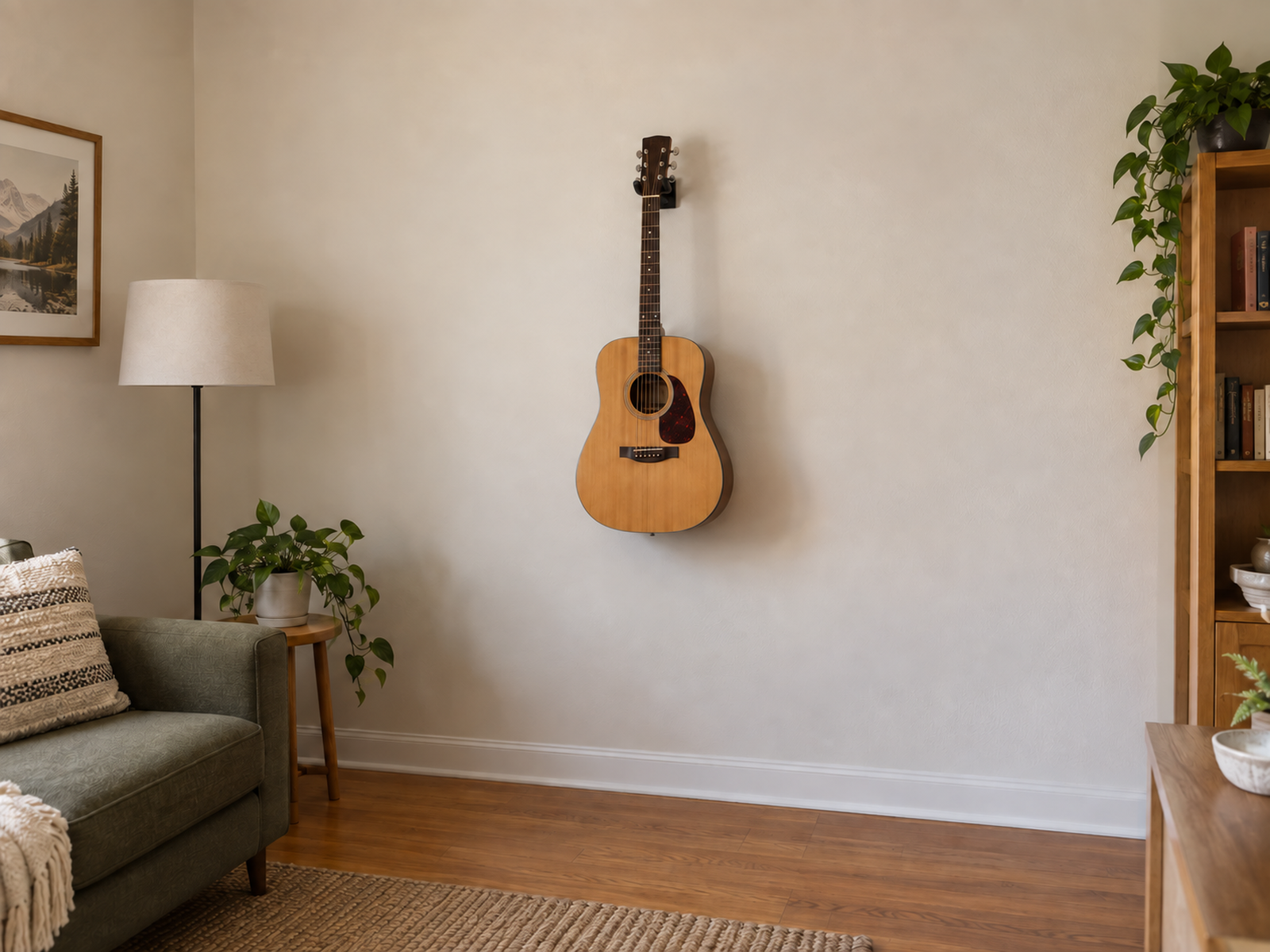
A wall hanger can recover almost all of the guitar’s floor footprint and keep a daily instrument visible, but it converts a storage problem into a structural installation problem.
Use the exact hanger instructions. Current String Swing products publish their own hardware, wall-installation guidance, instrument limits, and masonry caveats. Do not substitute a universal drywall-anchor rule based only on a package weight rating.
Check the instrument too. Weight, neck and headstock shape, body depth, finish/contact compatibility, and the room climate all remain part of the fit even when the hanger is structurally secure.
Finally, check the lease. Screw holes, anchors, rail systems, and repairs at move-out may require permission. A wall-saving solution is not renter-friendly when the attachment method conflicts with the property rules.
Use / Skip
Wall Hanging a Guitar
Use
Use it when the instrument, wall, climate, and lease all support the installation
Wall hanging can be a strong small-apartment solution when the exact hanger fits the guitar, the wall type and hardware are verified, the manufacturer installation instructions are followed, the room environment is appropriate, and the lease permits the required holes or anchors.
Skip
Skip it when any part of the load path or environment is uncertain
Keep the guitar on a verified floor stand or in its case when the wall structure is unknown, the lease prohibits drilling, the proposed wall is environmentally poor, the hanger contact is questionable for the finish, or the user cannot confirm a product-specific installation method.
06
Split a Multi-Guitar Collection by Use Frequency
Multiple guitars do not automatically need a denser version of the one-guitar solution. Start by separating the daily instrument from secondary, sentimental, vintage, or rarely used instruments.
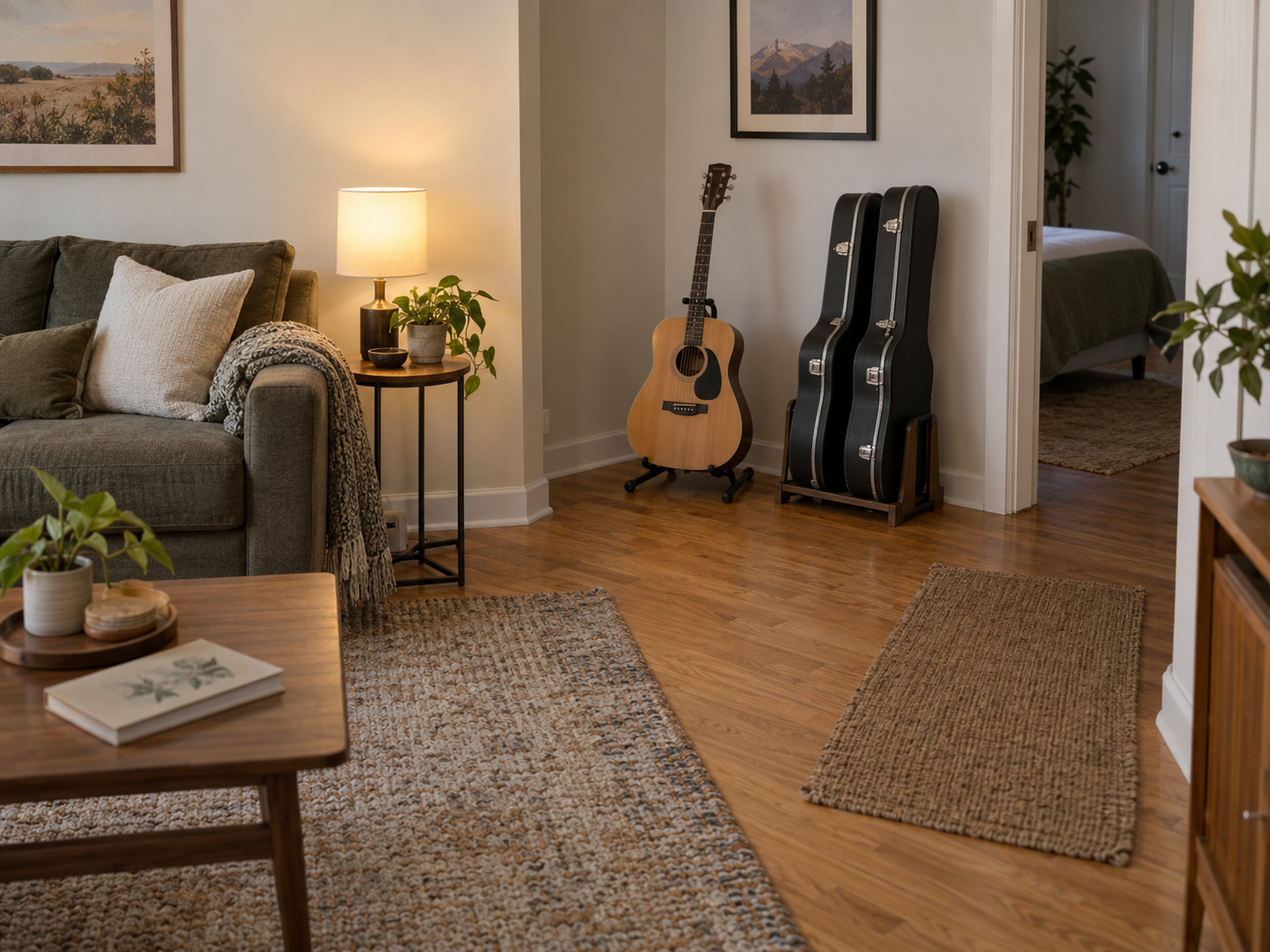
A multi-guitar floor rack can consolidate several instruments into one wall-adjacent floor zone without drilling, but it spends a larger continuous footprint and can make individual retrieval tighter.
A wall rail can recover more floor area, but it is a more permanent installation. Current String Swing rail systems publish per-hanger and stud-based load guidance, which reinforces that multi-guitar wall storage must be planned as a structural system rather than a row of decorative hooks.
Use mixed states when they reduce risk: one daily guitar accessible, secondary instruments in cases or a floor rack, and the most climate-sensitive or valuable instruments in protected storage.
07
Treat No-Drill Storage as an Installation Category, Not a Safety Conclusion
No-drill does not mean no load path. Tension posts transfer force into the floor and ceiling; pin-assisted or adhesive products transfer load into wall finishes and substrates; furniture-mounted systems transfer it into the furniture.
Products exist that are marketed specifically for rental or no-hole guitar storage, including tension-based systems, but each one has its own installation, load, surface, and compatibility requirements.
Do not improvise an adhesive hanger for a valuable instrument because a generic hook claims enough weight capacity. Long-term attachment, humidity, paint condition, wall texture, load direction, and guitar geometry can all differ from the rating scenario.
When no-drill evidence is weak or the lease language is unclear, a floor stand or case is the safer organizational fallback because its load path is easier to verify.
08
Move Low-Use Instruments Out of Prime Living Space When the Collection Outgrows the Apartment
When a collection exceeds the floor, wall, and closet resources the apartment can spare, stop optimizing every instrument for immediate access.
Low-use guitars can move into stable case storage in a slower closet zone or, when the collection is genuinely too large for the home, into verified off-site climate-controlled storage.
Off-site storage adds cost, access friction, insurance questions, and security requirements. Climate-controlled marketing should still be verified rather than assumed to meet the instrument manufacturer’s needs.
The goal is not maximum density. It is a deliberate split between instruments that earn daily apartment access and instruments that are safer when protected elsewhere.
Closing Decision
Spend the Least Valuable Storage Resource Without Spending Instrument Safety
A small apartment can store a guitar well without forcing one universal method. Case storage spends volume for protection, a floor stand spends floor area for fast access, and a wall hanger spends structural and lease capacity to recover the floor.
Start with play frequency and climate, verify the full instrument-plus-support envelope, and use mixed storage states when the collection grows. If the wall, room, or no-drill hardware cannot be verified, the case remains a strong fallback—not a compromise that needs to be disguised.
RELATED GUIDES
What to Read Next
NEXT GUIDE
How to Store Workout Gear in a Small Apartment Without a Dedicated Workout Room
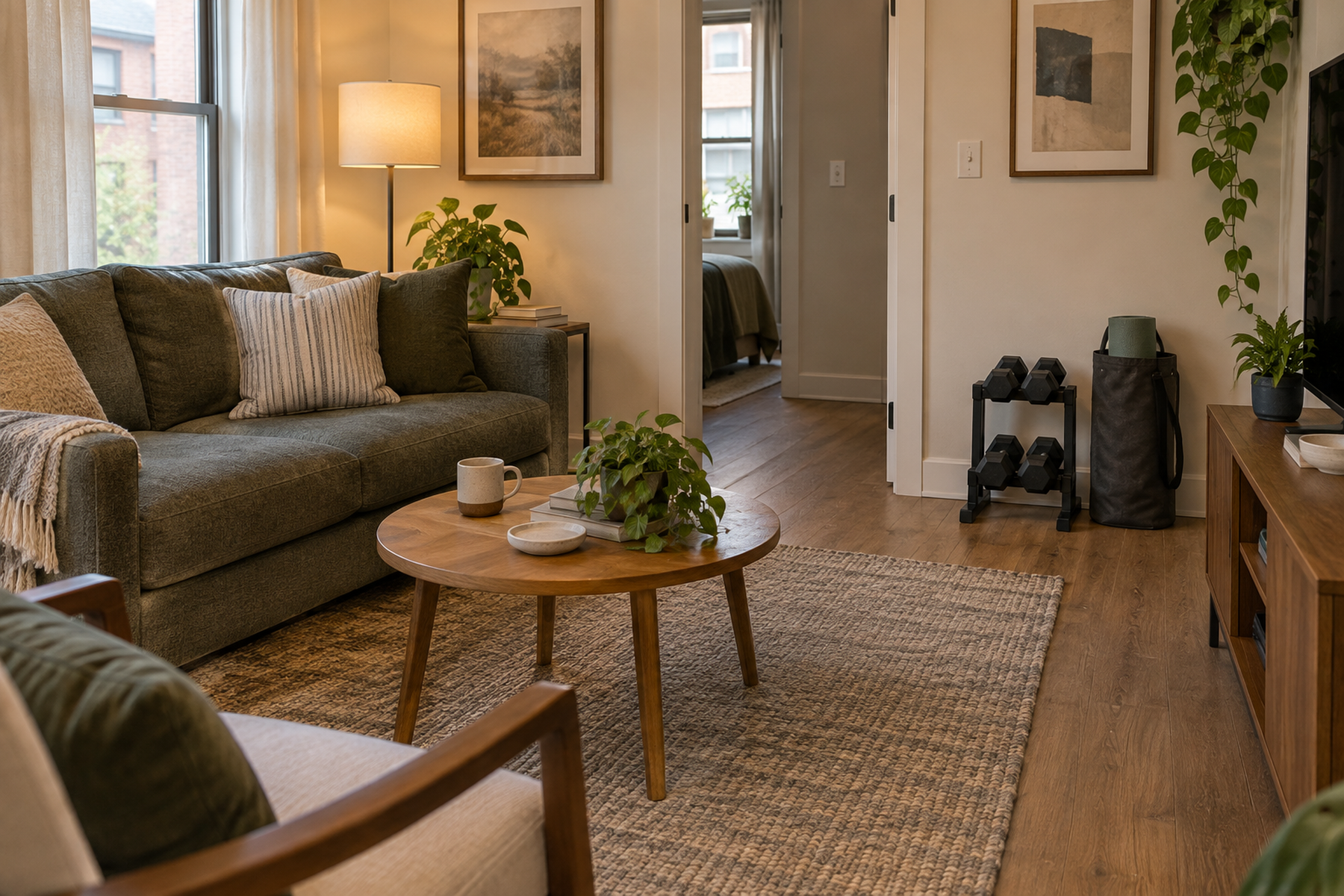
Use this next if guitars are only one category of hobby equipment competing with the living room or bedroom; that guide focuses on keeping regularly used gear accessible without giving it a dedicated room.
GUIDE
How to Store Books in a Small Apartment With No Room for a Bookcase
Use this if wall and floor capacity are already crowded by another visible collection; that guide compares how to spend limited wall, floor, and furniture space without defaulting to a full bookcase.
GUIDE
How to Store Holiday Decorations in a Small Apartment With No Storage Closet
Use this if low-use guitars or cases are competing with other bulky, infrequent items; that guide helps move low-frequency inventory out of prime everyday access.