
Small Closet Organization
How to Store Pants and Jeans in a Small Closet With No Dresser
Treat pants as a dual-plane category: fold the pairs that benefit from compact, visible shelf or bin storage, hang the pairs that gain from separation or wrinkle control, and spend rod width, shelf volume, floor space, and slower seasonal storage only where each resource earns its cost.
In This Guide
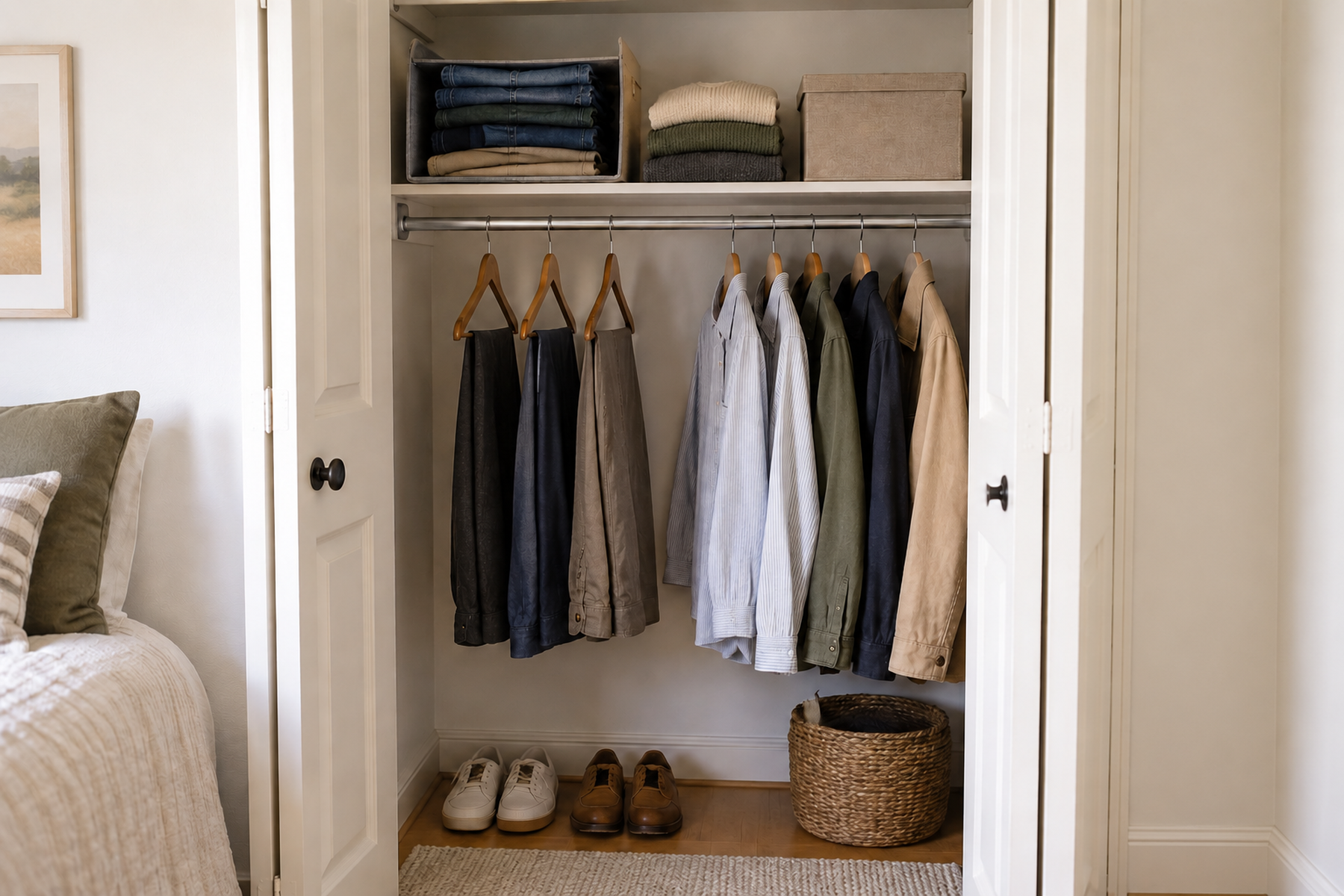
Pants and jeans are awkward in a small closet because the category can legitimately use more than one storage plane. A pair of jeans can fold onto a shelf or hang from the rod, while tailored or crease-sensitive trousers may justify hanging even when shelf space is available.
That makes the problem an allocation decision before it becomes an organizer decision. The useful system gives the most-worn pairs the shortest retrieval path, protects garments that benefit from hanging, and prevents thick denim, hanging organizers, or floor drawers from consuming the closet resource another category needs more.
Quick Answer
Choose the Closet Plane Before the Organizer
Do not make every pair use the same method. Split the category by garment behavior and access frequency, then decide whether each subset should spend shelf volume, rod width, floor space, or slower secondary storage.
01
Fold or hang jeans according to the closet, not a universal rule
Wrangler’s current denim guidance allows jeans to be folded or hung. Use the option that protects access and closet capacity rather than treating denim as a category with one mandatory storage method.
02
Reserve hanging space for pairs that gain from it
Tailored, wrinkle-sensitive, or frequently scanned trousers may justify individual hanging access, while casual jeans, joggers, and soft pants can often use folded storage when that plane is cheaper.
03
Judge the system by retrieval and laundry return
A shelf, bin, hanging organizer, or multi-pant hanger is only useful when one pair can leave and return without collapsing a stack, unloading several garments, or displacing another clothing category.
01
Split Pants by Garment Behavior Before Choosing Storage
Separate the pants category into garment types before assigning shelf or rod space. Denim jeans, chinos, joggers, tailored trousers, delicate pants, and dry-clean-only garments do not create the same storage problem.
For jeans, both folding and hanging can be legitimate. Wrangler’s current denim-care guidance explicitly allows either method, so the closet should decide which resource is cheaper rather than forcing every pair onto shelves or hangers.
Keep wrinkle and crease preferences in the decision. A tailored trouser that the user wants to keep visually smooth may earn hanging access even when a casual pair of jeans would work well folded in the same closet.
Use each garment’s care label for washing, drying, ironing, and related regular-care instructions. The FTC requires covered apparel to carry care directions and warnings, but the label does not prescribe one universal closet-storage method.
02
Build a Small Active Working Set
Give prime closet access to the pairs that actually move through the wardrobe every week. Formal trousers, seasonal pants, backup denim, or rarely worn styles do not need the same retrieval speed as the everyday working set.
A smaller active set can make a simple shelf, bin, or hanger group work better than a high-density organizer holding every pair the household owns.
Keep enough slack for a normal laundry return. If freshly washed pants only fit after rebuilding the shelf or compressing another category, the active zone is already over capacity.
Move low-frequency and off-season pairs to a slower storage location only when that location remains dry, practical to retrieve, and appropriate for the garments.
Measure / Check First
Before buying a hanging organizer, multi-pant hanger, bin, or floor drawer unit, measure the active pants group against the closet resources that each option will consume.
Check Folded Volume, Rod Cost, and the Return Path First
01
The real folded and hanging geometry
Measure folded jean thickness, shelf depth, bin dimensions, hanger width, garment drop, and the closet opening. Do not assume one pair count, stack height, or container size works across different pants and bodies.
02
What the new storage method displaces
For a hanging organizer or extra pants hangers, measure the rod width and vertical drop lost to shirts, jackets, dresses, shoes, or floor storage. For floor drawers, test hanging hems and door clearance.
03
The normal retrieval and laundry-return route
Remove a frequently worn pair and return a realistic clean laundry load. The system should not require rebuilding a pile, lifting several pairs, or moving another clothing category each time.
If a storage method increases nominal pants capacity but makes everyday retrieval, laundry return, or the rest of the closet worse, the trade is too expensive.
03
Use Low Folded Stacks When Shelf Access Is Already Good
A reachable shelf is the lowest-intervention home for jeans and casual pants when the active set is modest and one pair can be removed without collapsing the pile.
Keep stacks bounded and shallow enough for the actual garments. Thick denim consumes vertical space quickly, and there is no universal correct number of jeans per stack.
Avoid deep double rows for everyday pairs when the rear row disappears behind the front. Extra theoretical capacity is weak if the user cannot scan the category without unloading it.
Use simple shelf dividers only when they stop heavy stacks from spreading sideways; the divider should improve access rather than create another rigid obstacle inside a narrow shelf.
04
Use File-Folded Containers When Stacks Keep Collapsing
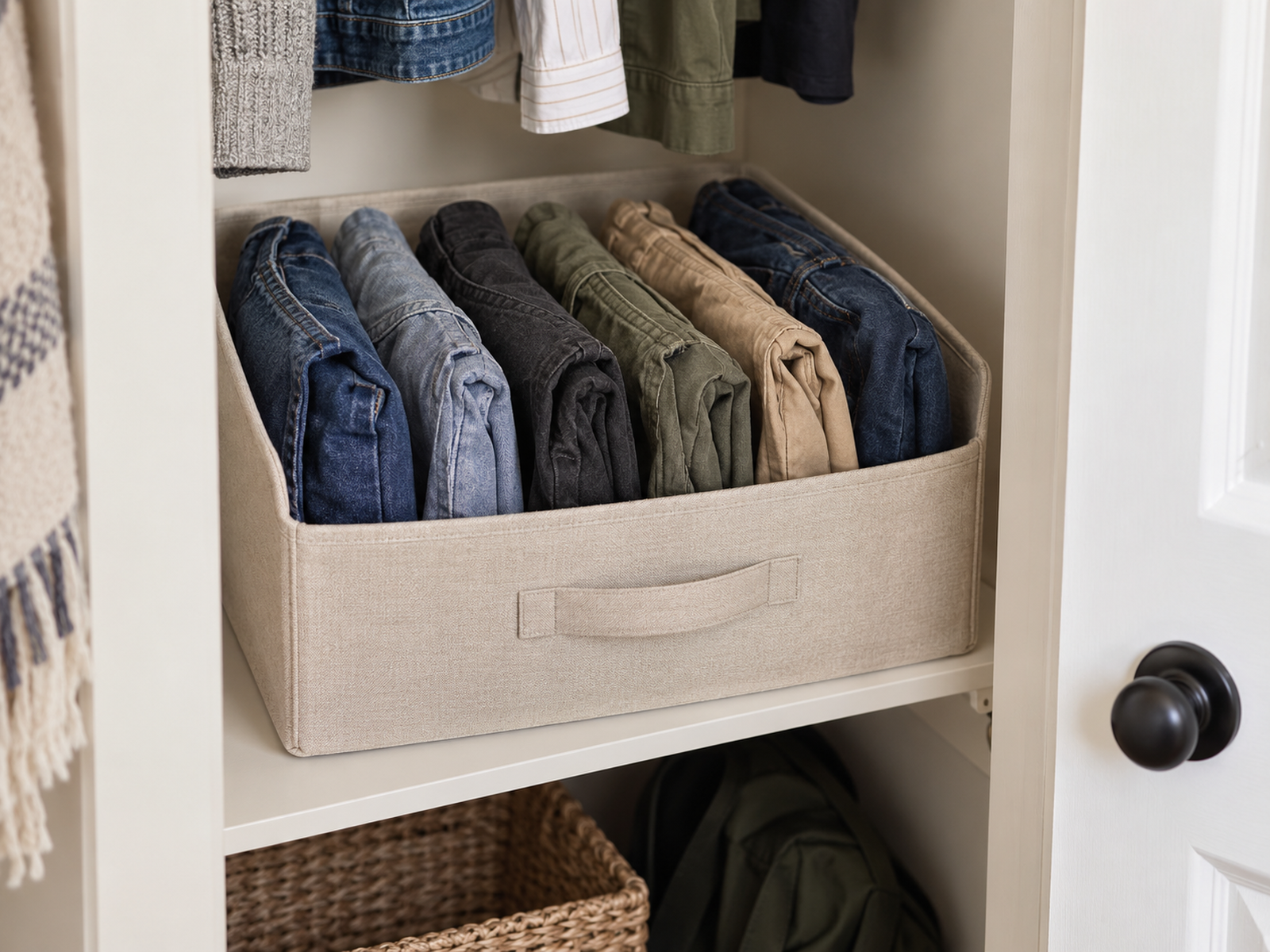
A bin or drawer-like container can turn thick jeans and casual pants from a pile into individually visible units. File folding is useful primarily because it can improve visibility and retrieval, not because it guarantees a universal volume saving.
Choose a container that matches the folded garment depth and can pull forward through the actual closet opening. A deep bin that hides the back row simply recreates the retrieval problem inside a different object.
Keep loaded weight in mind. Dense denim can make a large basket or bin heavy enough that pulling it from a high shelf becomes awkward even when the container technically fits.
Use this method when the category needs containment more than it needs hanging visibility, and keep the most-worn pairs toward the easiest viewing and grip position.
05
Convert Rod Width Into Folded Storage Only When the Trade Works
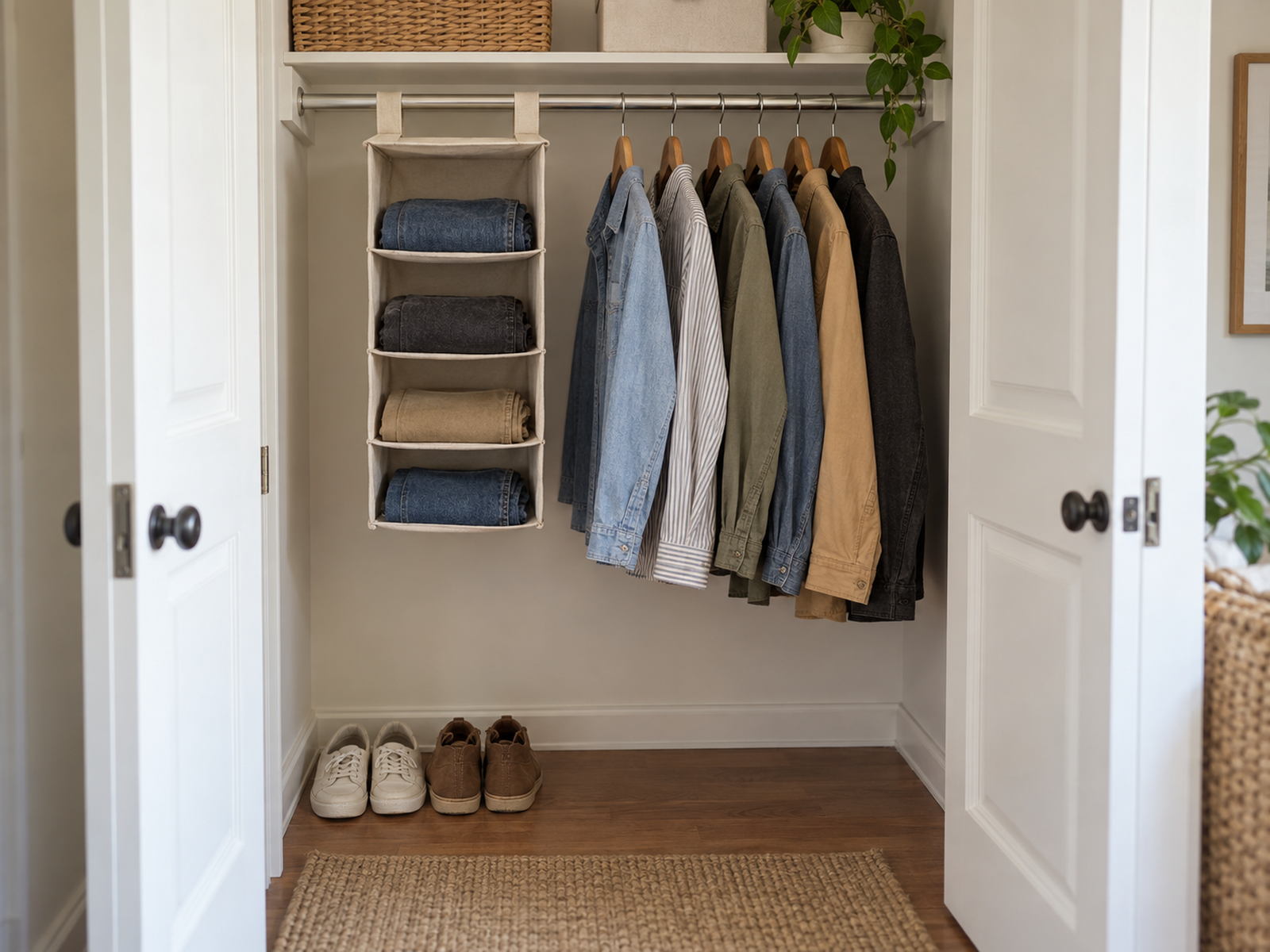
A hanging compartment organizer can create shelf-like storage in a rod-only or no-dresser closet, but it does not add storage for free. It converts rod width and vertical drop into folded capacity.
Current manufacturer products such as IKEA’s SKUBB six-compartment organizer verify the removable architecture and show why dimensions matter: the organizer occupies a measurable section of rod and hangs deep into the closet.
Use the conversion when the wardrobe has more hanging width than it needs and the pants category needs accessible folded storage more than shirts, jackets, or long garments need that section of rod.
Do not infer heavy-denim capacity from compartment count. The exact organizer, closet rod, supports, and loaded garment weight control.
Use / Skip
A Hanging Compartment Organizer for Pants
Use
Use it when folded capacity is scarcer than hanging capacity
A hanging organizer can be a strong renter-first choice when the closet can spare the rod width and vertical drop, the compartments fit the folded pants without deep sagging, and the organizer leaves enough space for garments that genuinely need the rod.
Skip
Skip it when the wardrobe needs the rod more than another set of shelves
Keep pants on existing shelves, in a bin, or in portable drawers when the organizer would crowd shirts, jackets, dresses, a lower rod, shoes, or the closet opening, or when heavy denim makes the soft compartments difficult to use.
06
Hang the Pants That Gain From Separation or Wrinkle Control
Individual trouser or skirt hangers are useful when seeing each pair separately matters more than conserving rod width. Current hanger formats with adjustable clips verify that trousers can be stored as individual hanging units.
Folding trousers over a hanger bar is another tool-free option when the garment tolerates the fold and the user accepts the resulting crease. The right choice depends on garment construction and the desired finish.
Multi-pant hangers can consolidate several pairs onto one piece of hardware, but they do not make the fabric volume disappear. Loaded weight, layered retrieval, garment thickness, and vertical clearance become the new constraints.
Use multi-pant hardware when it improves scanning and rod organization for the actual wardrobe; do not treat tier count as a direct multiplier of closet capacity or a universal load rating.
07
Spend Floor Space on Portable Drawers Only When the Closet Can Afford It
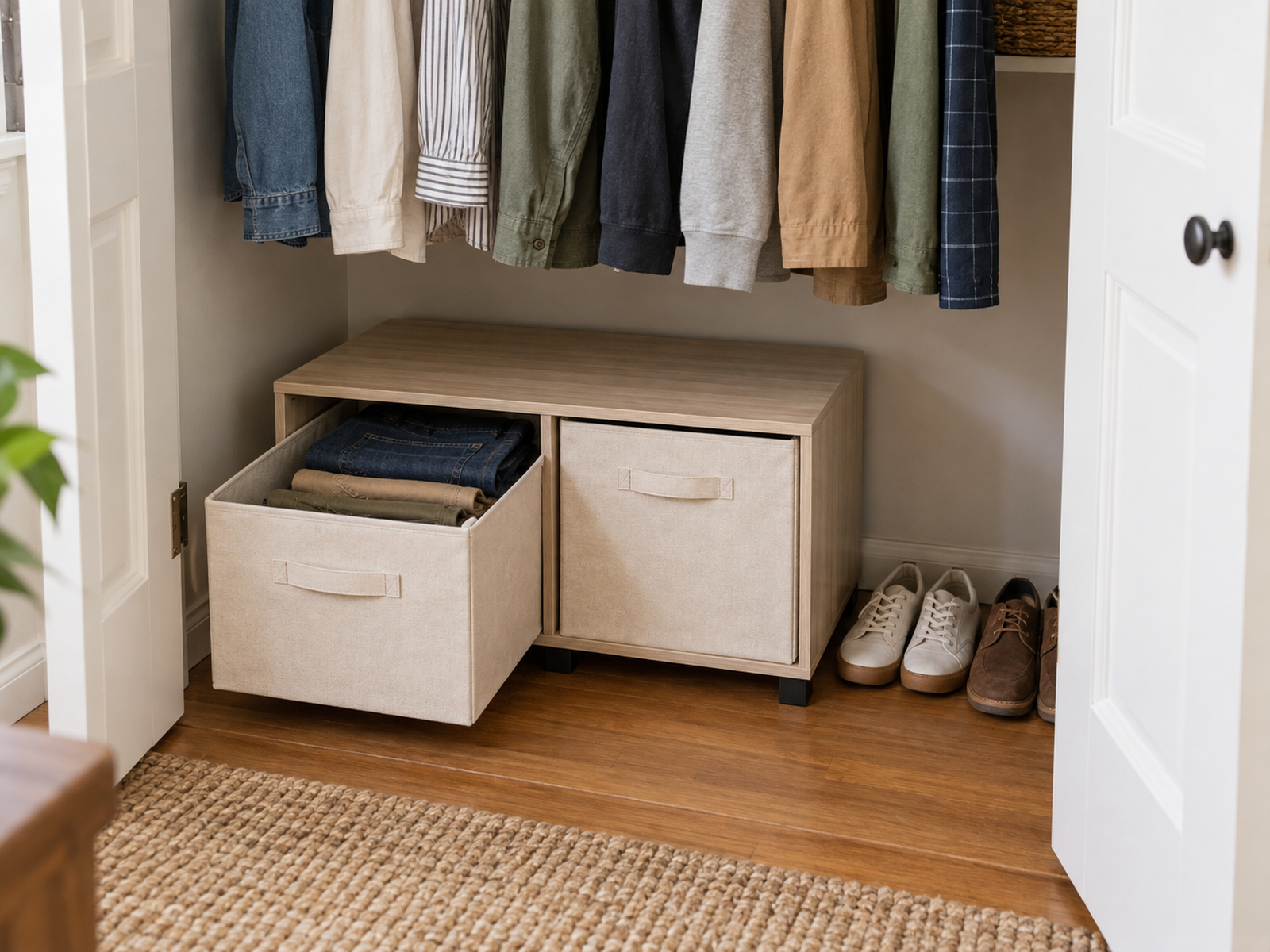
A low portable drawer or cube can recreate dresser-like containment inside the closet without spending additional rod width or installing fixed hardware.
Place it under short-hanging garments or in an open side bay only when the drawers can open through the real closet doorway and hanging hems remain clear.
The cost is floor capacity. Shoes, bags, laundry, and long garments may already have stronger claims on that plane, especially in a narrow reach-in closet with sliding doors.
Installed pull-out trouser racks belong later. Current systems such as IKEA KOMPLEMENT are designed for specific compatible wardrobe frames, so fit, hardware, interior dimensions, and renter permission must be verified rather than generalized from the idea.
08
Make Laundry Return the Final Capacity Test
A pants system is not successful because it looks neat immediately after organizing. It has to survive wearing, washing, drying, choosing, and returning garments without a major reset.
Keep the everyday working set where one pair can leave and return independently. Move formal, seasonal, or low-frequency pants to slower storage before increasing density around the most-used pairs.
Store garments clean and fully dry before dense or long-term storage. Denim manufacturers such as Levi’s and Wrangler emphasize drying guidance and avoiding damp or cramped storage conditions, while exact care should still follow the garment’s label.
If every shelf, rod, organizer, and floor option remains over capacity, the stop rule is not another pants gadget. Reduce the prime-zone inventory, change the seasonal allocation, or reconsider which clothing categories deserve the closet’s limited planes.
Closing Decision
Let Each Pair Use the Closet Plane It Actually Earns
Pants and jeans do not need one universal storage method. A small closet works better when everyday casual pairs use stable folded access, garments that benefit from separation or wrinkle control use the rod, and low-frequency pants stop competing for the fastest storage.
Choose the active working set first, then make the rod-versus-shelf trade explicit. Use hanging compartments only when folded capacity is scarcer, use portable drawers only when floor space is cheaper, and let the laundry-return test decide whether the system is genuinely sustainable.
RELATED GUIDES
What to Read Next
NEXT GUIDE
How to Store Folded Clothes in a Small Closet With No Dresser
Use this next if pants are only one part of the no-dresser problem; that guide handles the broader folded-clothing system across shelves, bins, rod conversions, and floor storage.
GUIDE
How to Organize a Small Closet With No Built-In Shelves
Use this if the closet starts as a rod-only shell; that guide focuses on creating renter-friendly folded-storage planes before pants-specific allocation is layered in.
GUIDE
How to Store Off-Season Clothes When Your Small Closet Has No Extra Space
Use this if seasonal pants are consuming the active zone; that guide covers the broader demotion and secondary-storage system for low-frequency clothing.