
Small Apartment Storage Ideas
How to Store a Full-Size Stroller in a Small Apartment With No Entryway
Treat the stroller as a daily-use object with three states—arrive, reset, park: protect the apartment exit, contain dirty or wet wheels before storage, use the exact manufacturer-supported fold, and choose the lowest-friction private storage zone that does not turn a shared hallway or rental wall into the new problem.
In This Guide
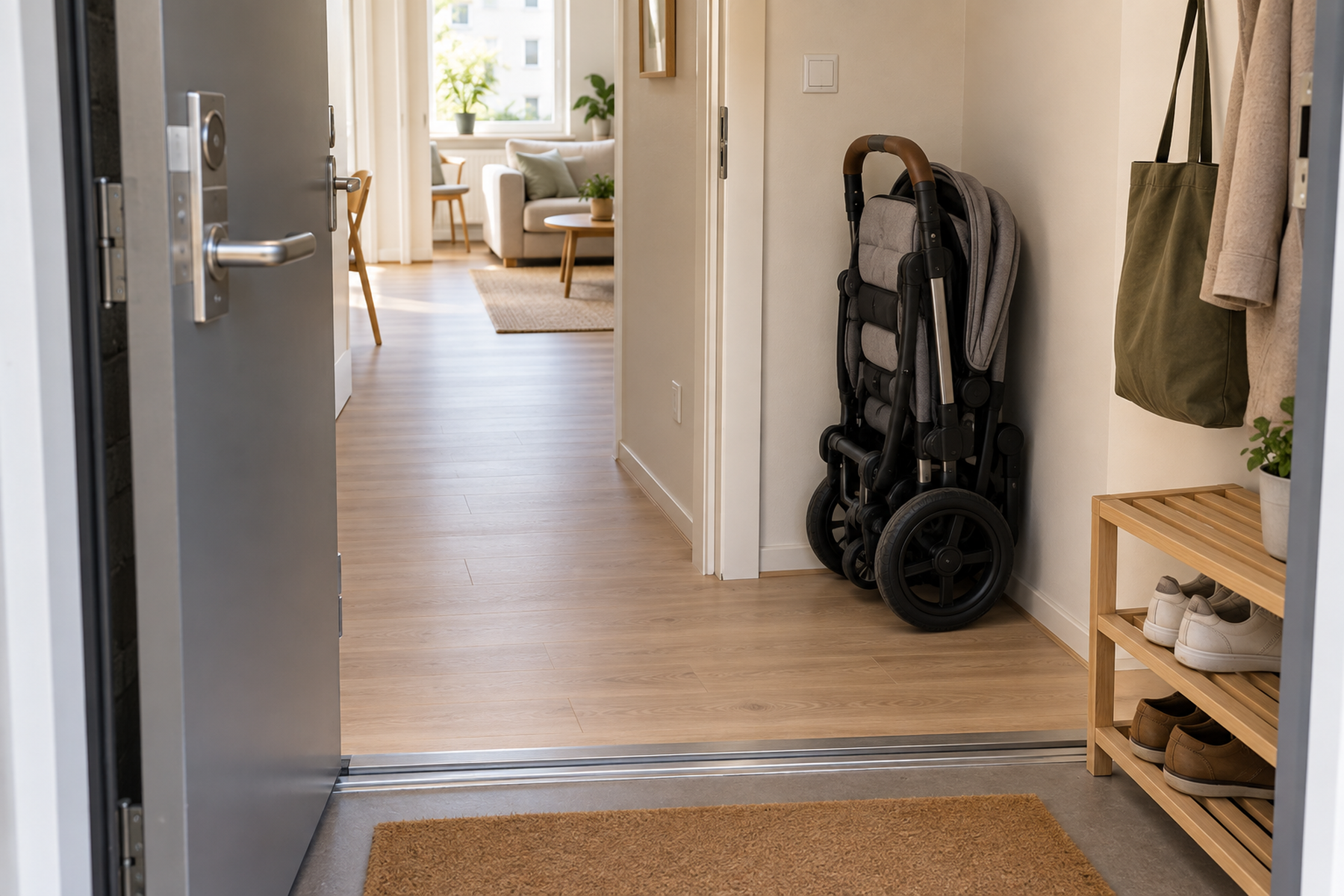
A full-size stroller can be one of the most useful and most awkward objects in a small apartment. It may leave the home every day, return with wet or gritty wheels, remain nearly as wide after folding, and compete with the front door, coats, shoes, groceries, and the only clear path through the room.
The strongest system therefore solves the stroller as a daily cycle rather than a one-time hiding problem. The stroller arrives, gets reset for dirt or moisture, moves into a stable parked state, and stays easy enough to retrieve that the household will actually use the system every day.
Quick Answer
Design the Route Before You Pick the Storage Hardware
Start with the exact stroller, not a generic “folded stroller” idea. Protect the apartment exit, measure the manufacturer-supported folded state, and choose the private storage plane that adds the least daily friction.
01
Keep the exit path unavailable for stroller storage
A stroller near the front door can be convenient, but it should not interfere with the door swing, locks, normal entry, or the apartment’s way out. Shared corridors and lobbies also require building and local-rule checks.
02
Measure the folded stroller that you actually own
Check folded width, depth, height, weight, standing stability, accessory projections, and whether the fold keeps the seat attached. “Compact fold” and “self-standing” are model-specific features, not category-wide assumptions.
03
Optimize for the daily put-away and launch routine
A closet, wall hook, or behind-sofa position can save visible floor space and still fail if it requires lifting, disassembly, moving furniture, or carrying dirty wheels through the whole apartment several times a day.
01
Start With the Stroller’s Real Fold and Daily Handling
Begin with the owner’s manual and the stroller you actually use. Follow the manufacturer’s fold and lock sequence rather than forcing the frame into a position that merely looks smaller.
Published stroller dimensions show why this matters. UPPAbaby’s current Vista V3, for example, substantially reduces front-to-back depth when folded but keeps the same published width. A stroller can therefore become much shallower without becoming narrow enough for every doorway, closet, or behind-door gap.
Weight belongs in the same test. A wall or over-door system can be rated for the load and still be a poor daily solution if the user has to lift a heavy stroller while also managing a child, bags, or groceries.
Include accessories in the real stored envelope. Rider boards, bassinets, extra seats, snack trays, organizers, rain covers, and parent bags can create a second storage problem even when the stroller frame itself folds well.
02
Protect the Exit and Build an Arrival-to-Parking Route
Map the stroller’s route from the apartment door to its parked zone before assigning the location. The route has to work when the stroller is unfolded, when a child or bags still need attention, and when the wheels are wet or dirty.
Protect the apartment entrance and normal way out. Do not let the stroller body, handlebar, folded frame, accessory bag, shoe pile, or storage hook turn the threshold into a narrow obstacle course.
Treat shared hallways as an external dependency, not free square footage. New York City, for example, restricts personal-property storage including baby strollers in building corridors except where specifically allowed, and building rules can be stricter or different elsewhere.
The best daily route is usually short, but “closest to the door” is not automatically best. A stroller can live one step farther into the apartment if that preserves the exit and keeps the storage action simple.
Measure / Check First
Before buying a hanger, clearing a closet, or committing to a behind-furniture gap, test the stroller in the exact arrival and parked states the household will repeat every day.
Check the Folded Envelope, Daily Lift, and Exit Path First
01
The true folded and standing envelope
Measure folded width, depth, height, handle and wheel projections, any self-standing footprint, and the extra space needed to unfold or retrieve the stroller without striking the wall or door.
02
The repeatable handling load
Use the stroller’s real weight and the user’s normal routine. If a solution requires a lift, hook, turn, or partial disassembly, test whether that action is reasonable while also managing a child or bags.
03
The arrival reset and clear route
Open the apartment door fully, preserve the way out, identify where wet or gritty wheels can pause, and trace the cleanest short route to the final parked position without moving furniture.
If the stroller fits only after removing several parts, blocks the exit when standing, or requires a lift the household will avoid on a busy day, the storage location is too expensive operationally.
03
Create a Dirty-Wheel Landing State Before Final Storage
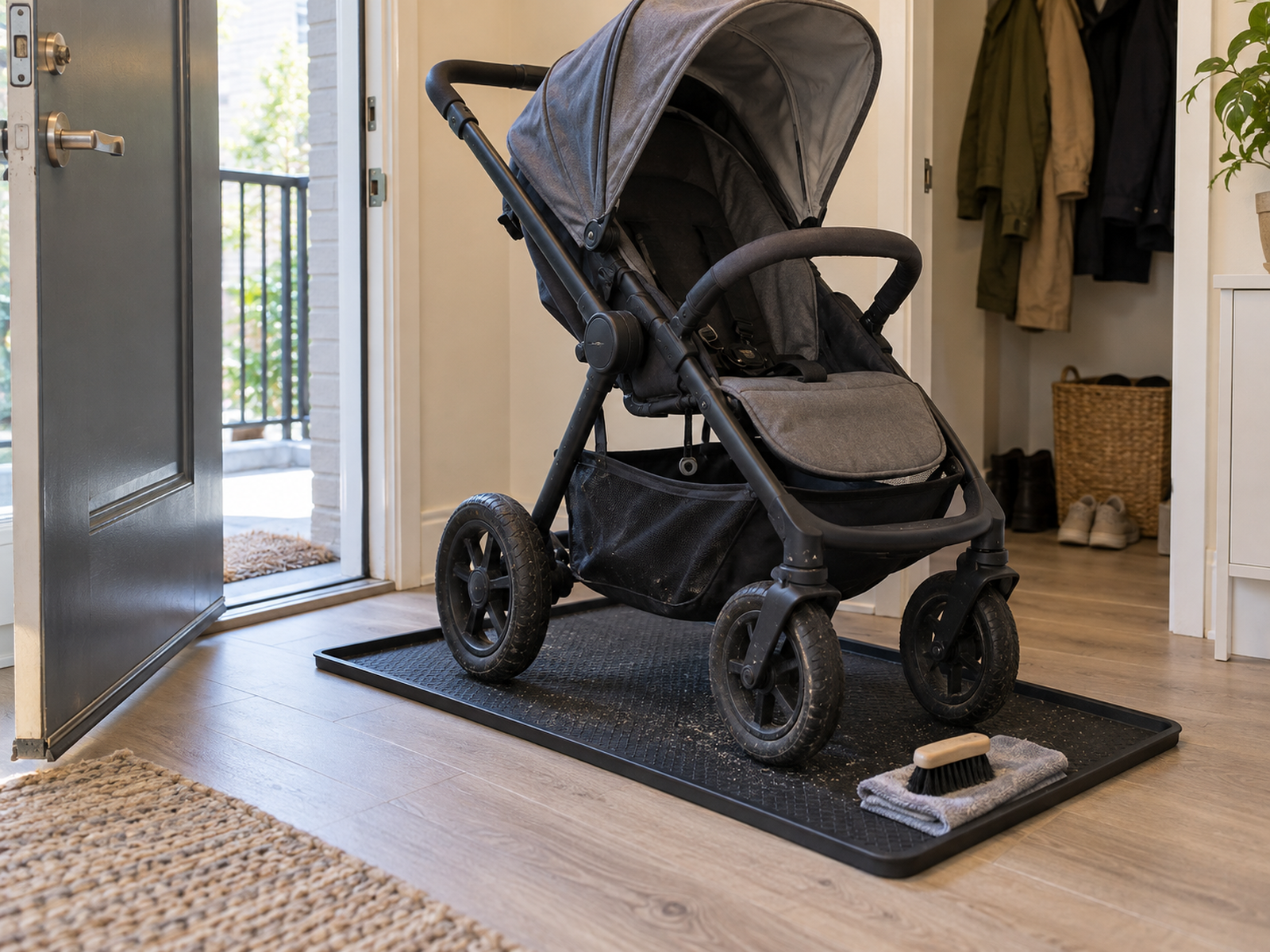
Outdoor wheels can carry water, snow, salt, grit, mud, and street debris into the apartment. Give the arrival state a temporary landing surface before the stroller travels farther inside.
A washable mat or boot tray can contain wheel moisture and debris when it fits outside the door swing and does not become a trip hazard. This is a housekeeping and workflow tool rather than a claim that a tray sanitizes stroller wheels.
Dryness can also change the storage decision. UPPAbaby’s Vista V3 manual, for example, says not to fold or store the product while damp or wet and not to store it in a damp environment. Follow the exact stroller manual rather than assuming every wet stroller can go straight into a closet.
Keep this reset simple. A daily-use stroller system is stronger when the household can park briefly, remove obvious dirt or moisture, and move to final storage without turning every outing into a cleaning project.
04
Use a Self-Standing Fold Only When It Really Reduces the Footprint
A stroller that stands when folded can be one of the strongest small-apartment architectures because it trades long floor depth for a more compact vertical parked shape without drilling or adding a separate rack.
Use the exact manufacturer-supported standing fold. Some current full-size strollers are designed to stand when folded; others lean, lie flat, or become stable only after a seat or accessory is removed.
Place the folded stroller beside the entry, in a low-traffic corner, or near a closet only when the resulting width and handle projection stay out of the door swing and walking path.
Do not judge the setup by floor footprint alone. The stroller still needs a handhold and enough room to tilt, lift, or unfold for the next trip without scraping the wall or forcing the user into a narrow stance.
Use / Skip
A Self-Standing Fold Near the Apartment Door
Use
Use it when the fold is stable and the exit remains fully clear
A self-standing fold can be a strong daily-use solution when the exact stroller supports it, the folded depth is materially smaller, the parked width stays outside the door and escape path, the wheels can be reset before storage, and the stroller can be launched again without moving furniture.
Skip
Skip it when the fold still blocks the threshold or will not stand reliably
Choose a closet, behind-furniture, hanging, or other private storage zone when the folded stroller remains too wide, tips easily, projects into the door swing, or requires accessories to be removed and rebuilt every time.
05
Spend Closet Capacity Only When Retrieval Stays Simple
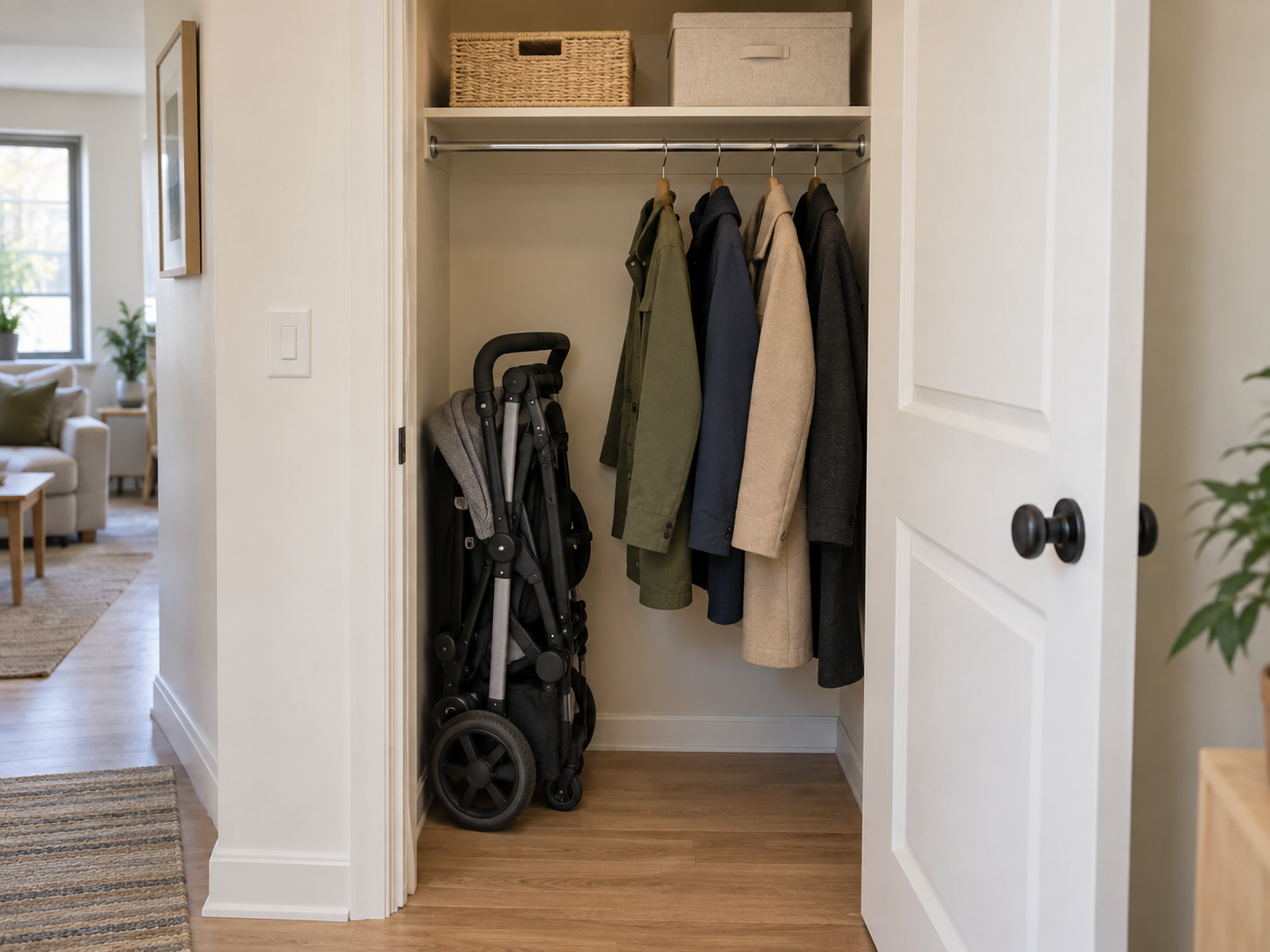
A coat or utility closet can remove the stroller from the living area, but it spends some of the apartment’s most useful enclosed storage. Measure the closet opening as well as the interior depth.
Test retrieval with coats, vacuum equipment, shoes, and other real closet categories in place. A stroller that technically fits but requires unloading half the closet each morning is not an accessible daily system.
Use enclosed storage only after the stroller is dry enough for that environment and after any model-specific storage instructions have been satisfied.
Protect the closet’s remaining functions. If the stroller consumes the full opening or blocks household essentials that have nowhere else to go, a visible but lower-friction parking zone may be the better small-space decision.
06
Use Over-Door or Wall Storage Only With Verified Load and Fit
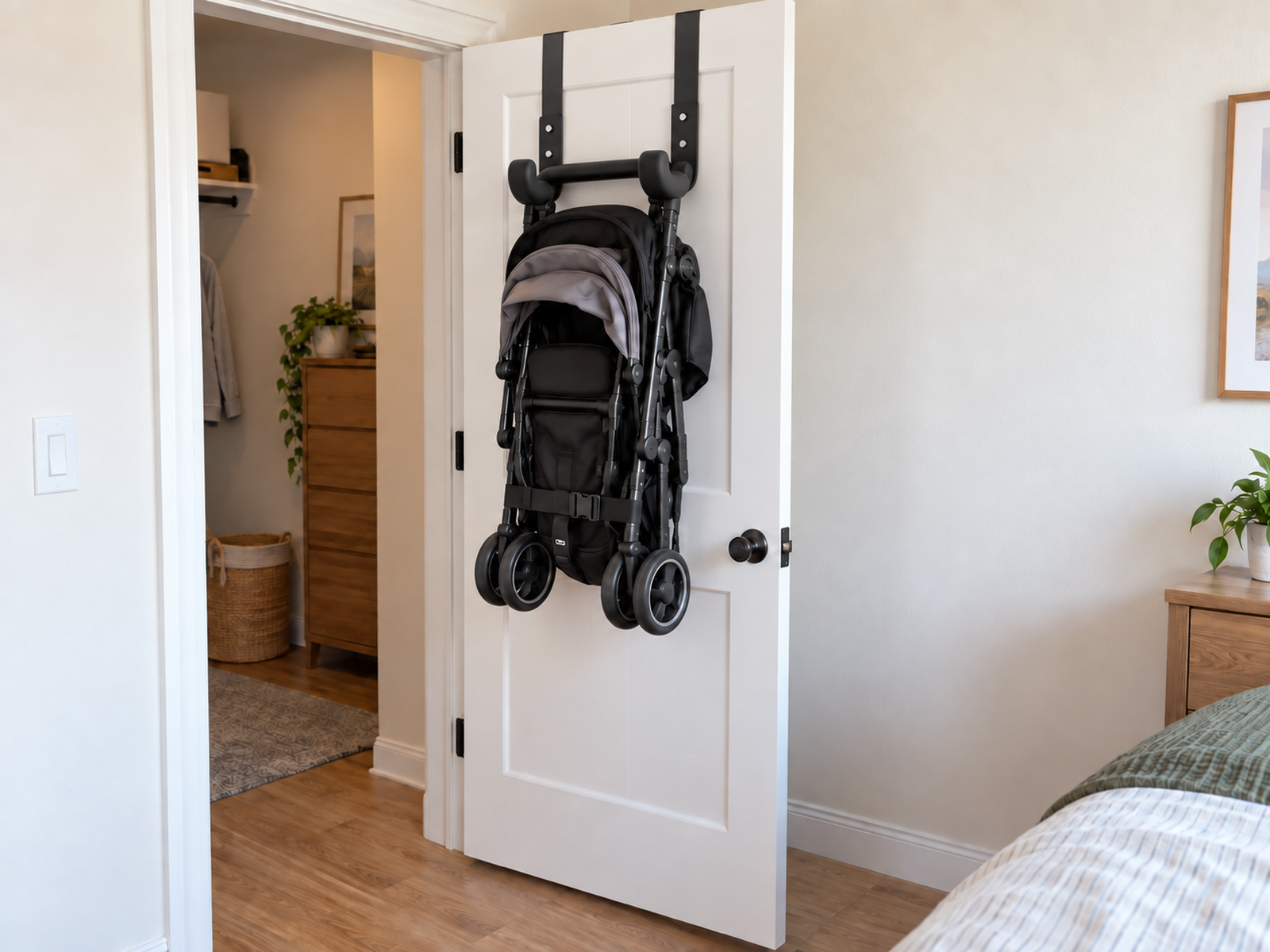
Over-door storage can recover floor space without drilling, but the door becomes part of the load path. Product-specific limits matter: Dreambaby’s current Strollerbuddy StrollAway, for example, publishes a 50-pound maximum for compatible strollers.
Test the exact door thickness, top gap, trim, latch, swing, wall contact, handle clearance, stroller weight, and loaded projection. “No drilling” does not make an over-door system universally compatible with rental doors.
Wall mounting is a higher-intervention branch. Verify the mount rating, stroller support point, wall structure, fasteners, stored projection, daily lifting effort, and landlord or lease permission before treating the wall as available storage.
Do not substitute a generic bicycle or garage hook merely because part of the stroller fits it. The exact support geometry and intended storage orientation need to be appropriate for the stroller and the hardware.
07
Treat Shared Building Storage as a Permission and Security Decision
A building-provided stroller, bike, or storage room can remove the stroller footprint from the apartment entirely when the property explicitly authorizes that use.
Check access hours, elevator or stair route, security, drying conditions, and whether daily retrieval still works for the household. Exporting the stroller footprint is only useful when the storage room does not add a difficult launch routine.
Do not treat the lobby, corridor, stair landing, or space outside the apartment door as private overflow storage without verification. Local fire or housing rules and building management can prohibit stroller storage even when the corridor appears wide enough.
If the shared option is insecure or impractical, bring the decision back inside the apartment rather than solving one space problem by creating theft or egress risk elsewhere.
08
Make Daily Friction the Final Test Before Replacing the Stroller
A storage system should survive the hardest ordinary moment: returning home with a child, bags, wet wheels, and limited free hands. If the stroller can only be stored neatly during a careful weekend reset, the system is too fragile.
Separate the stroller frame from accessory storage when that improves the parked envelope. Small bags, rain covers, rider boards, snack trays, or an extra seat may deserve their own hook, bin, or closet shelf instead of staying attached to the frame.
A smaller or travel stroller can become a later branch when the child’s age, ride quality, basket capacity, weather protection, terrain, car-seat needs, and household routine still work. Do not treat replacement as the automatic first answer to an apartment-storage problem.
The final goal is not invisibility. It is a stroller that can arrive, reset, park, and leave again without blocking the apartment or forcing the household into a storage ritual it will not maintain.
Closing Decision
Give the Stroller a Daily Route, Not Just a Parking Spot
A strong small-apartment stroller system protects the way out, follows the exact fold, contains dirty or wet wheels before enclosed storage, and puts the stroller in the lowest-friction private zone the apartment can spare.
Use a self-standing fold when the model truly supports it, spend closet space only when retrieval remains easy, and treat over-door, wall, or shared-building storage as conditional systems with real load, permission, and egress boundaries. The best solution is the one the household can repeat every day.
RELATED GUIDES
What to Read Next
NEXT GUIDE
How to Create Entryway Storage When Your Apartment Has No Entryway
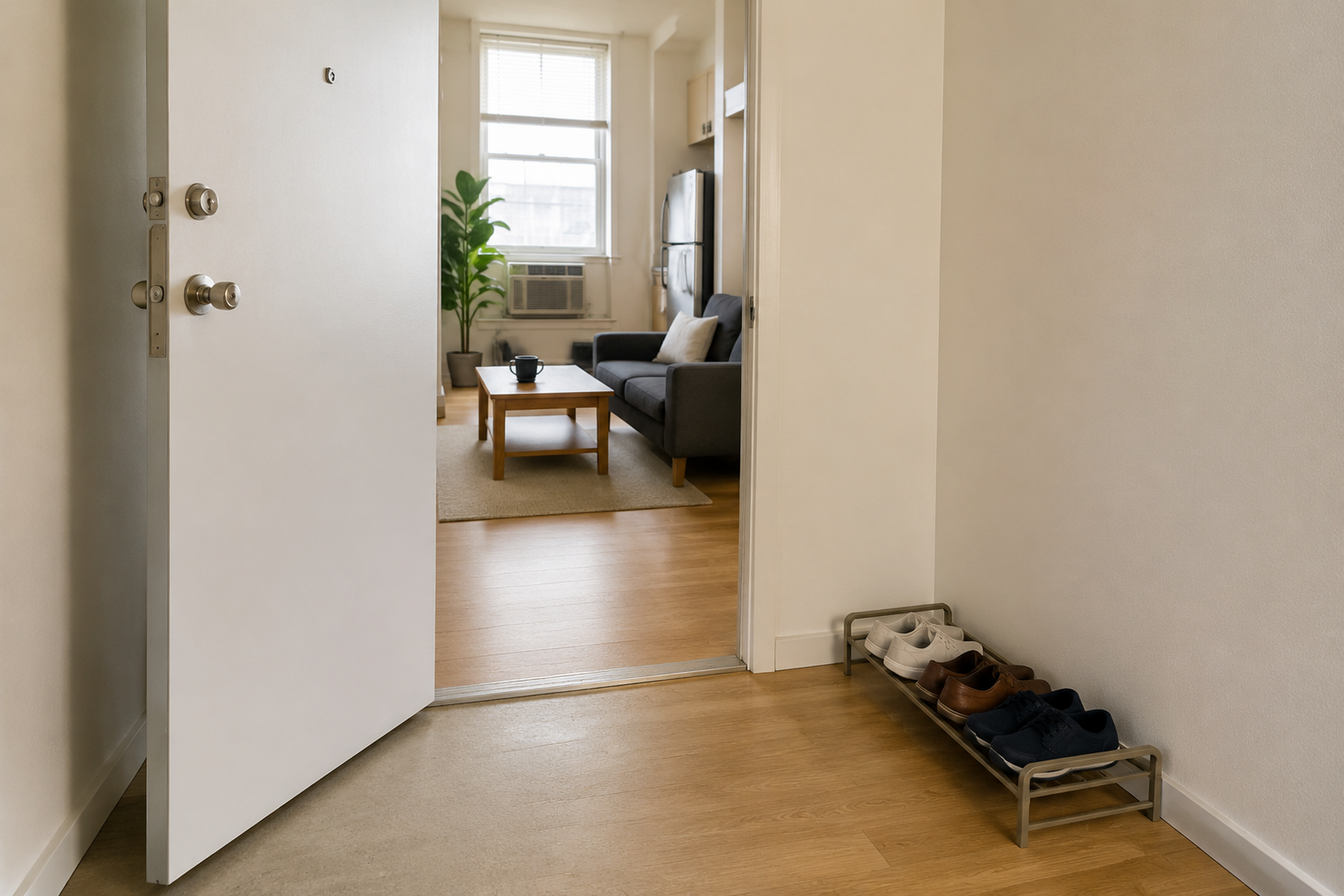
Use this next if the stroller is only one part of a crowded threshold; that guide handles shoes, bags, coats, and daily arrival items without letting the entry become permanent clutter.
GUIDE
How to Store a Bike in a Small Apartment With No Bike Room
Use this if the household also stores a bicycle indoors; that guide covers bicycle-specific parked-envelope and support decisions rather than stroller fold and child-handling constraints.
GUIDE
How to Dry and Store Wet Umbrellas in a Small Apartment With No Entryway
Use this if rain and wet-weather arrivals are making the threshold harder to manage; that guide focuses on containing and drying another wet entry-state object.