
Small Closet Organization
How to Store Sweaters in a Small Closet With Limited Shelf Space
Treat sweaters as shape-sensitive folded inventory, not generic clothes: keep the active-season group visible, convert rod or floor space only when the closet can afford it, and move clean off-season knitwear into protected secondary storage instead of forcing every sweater into prime closet space.
In This Guide
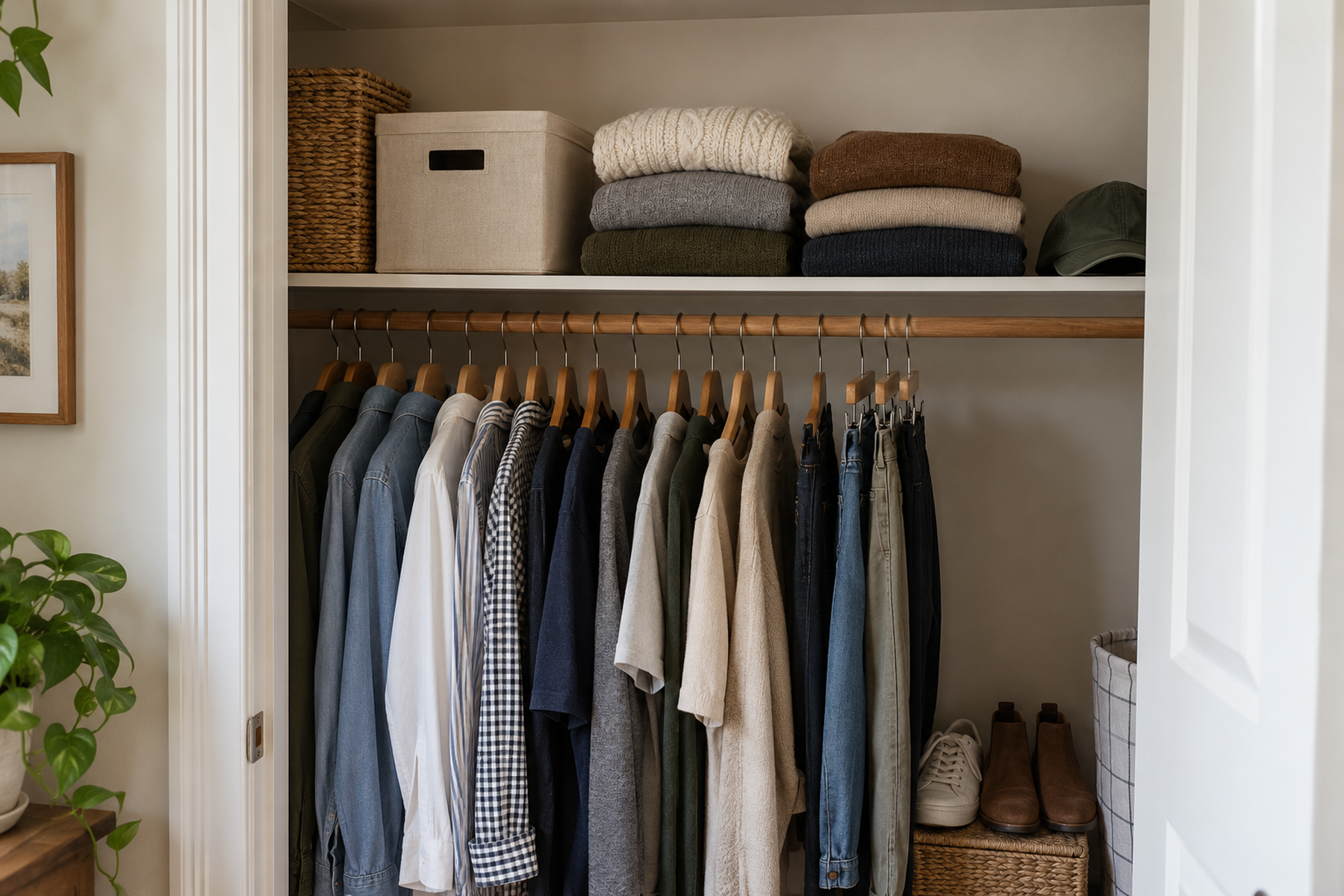
A small closet can have plenty of hanging rod and still be a poor place for sweaters. Bulky knitwear can overwhelm a shallow shelf, disappear at the bottom of tall stacks, or consume a large share of the closet when every sweater is kept in the same prime-access zone.
Garment behavior changes the storage decision too. Woolmark recommends folding wool garments rather than hanging them for storage to help them retain shape, while other sweater fibers and constructions can behave differently. The goal is therefore to give the sweaters that need frequent access a stable folded home without spending more shelf, rod, floor, or secondary-storage capacity than the wardrobe can afford.
Quick Answer
Protect Shape First, Then Spend the Cheapest Closet Resource
Decide which sweaters need active-season access before adding organizers. The strongest system keeps shape-sensitive knitwear folded, visible, and easy to return while moving low-frequency sweaters out of prime closet space.
01
Keep wool-specific advice wool-specific
Woolmark supports folding wool garments for storage rather than hanging them. Do not silently turn that into a universal rule for every cotton, synthetic, blended, lightweight, or structured sweater.
02
Reserve prime space for the active season
Sweaters worn weekly need easy retrieval and an easy return path after laundry. Off-season or rarely worn knitwear can move to protected secondary storage instead of consuming the best shelf or cubby all year.
03
Treat every organizer as a space trade
A hanging cubby converts rod width and vertical drop into folded storage; a floor unit spends shoe and floor space; under-bed storage spends immediacy. Choose the trade the closet can actually afford.
01
Start With the Sweater, Not the Empty Space
Sort the sweaters by material, construction, weight, and how often they are worn before assigning any shelf or organizer. The same empty cubby can be a good home for one garment and a poor one for another.
For wool, folding has direct authoritative support. Woolmark advises folding wool garments rather than hanging them for storage to help retain their shape, and its sweater-care material documents stretching and shoulder distortion associated with hanger use.
Keep that evidence inside its boundary. “Sweater” is not one fiber class, so cotton, synthetic, blended, structured, and lightweight knits should not automatically inherit a wool-specific rule when their construction or garment guidance differs.
Use the garment’s care label for cleaning and drying instructions. U.S. care labels are meant to provide garment-specific regular-care directions and warnings, which is more reliable than treating every knit as though it has the same laundry routine.
02
Separate Active-Season Sweaters From Off-Season Storage
The most important capacity decision may be how many sweaters deserve daily closet access. A sweater worn every week and one that will not be touched for six months should not consume the same level of prime storage.
Keep the current-season group where it can be seen, removed, and returned without unloading other containers. That may be a reachable shelf, a narrow hanging cubby, or a low drawer or cube inside the closet.
Move genuinely off-season sweaters to under-bed or other secondary storage when that zone is available and practical. This does not mean every sweater should leave the closet; it means access level should match use frequency.
The active zone should also absorb a normal laundry return. If clean sweaters only fit after the whole shelf is rebuilt, the category is still over-allocated even when the closet looks tidy immediately after organizing.
Measure / Check First
Before buying a hanging organizer, drawer unit, or storage case, measure the active sweater group against the actual closet resources it would consume.
Check Active Volume, Rod Conversion, and the Return Path First
01
The active-season sweater volume
Count the sweaters that need regular access and test their real folded thickness on the intended shelf or cubby. Do not invent a universal stack height or sweater count; the useful limit is the point where retrieval and return stop being stable.
02
Rod width, drop, depth, and support
For a hanging cubby, measure organizer width, closet depth, vertical drop, remaining hanging width, long-garment clearance, floor or shoe clearance, and door access. Do not infer the closet rod’s safe loaded capacity from appearance.
03
The reset path after wear and laundry
Make sure one sweater can leave and return without unstacking several bins, moving long garments, or rebuilding the whole zone. Secondary storage should be reserved for garments that can tolerate lower-frequency retrieval.
If the new organizer increases theoretical capacity but makes a normal sweater harder to see, remove, or return, the system is denser without becoming more usable.
03
Use Existing Shelf Space With Bounded, Visible Stacks
An existing shelf is the lowest-intervention sweater zone when it is reachable enough for the access frequency and deep enough to support the folded garments without pushing them into a hidden second row.
Keep piles bounded rather than chasing maximum height. No universal correct stack height was established in the research, so the practical test is whether one sweater can be removed without collapsing the pile beside or above it.
Shelf dividers or open-front bins can create boundaries when soft knitwear spreads sideways, but containment should improve retrieval rather than turn the shelf into a series of deep rummage boxes.
A top shelf can still be the wrong active-season zone even when it technically holds every sweater. If visibility is poor or returning laundry requires a step stool and stack reconstruction, use that shelf for lower-frequency sweaters and spend a more accessible resource on the active group.
04
Convert Rod Width Into Folded Storage With a Hanging Cubby
A hanging cubby is useful precisely because it converts a resource the closet may have—rod width and vertical drop—into a resource it lacks: folded shelves. That is a trade, not free capacity.
Current manufacturer products verify the category. IKEA’s SKUBB six-compartment organizer, for example, is designed to hang in a wardrobe for folded clothing, and its roughly 49-inch drop shows why long-garment and floor clearance must be measured before purchase.
Use a cubby when the closet can spare the width, short-hanging garments leave enough drop, the organizer fits the closet depth, and the existing rod and supports are appropriate for the real loaded weight.
Do not convert an already-stressed rod into a heavy sweater tower by assumption. Compartment count is not a load rating, and the cited product example does not establish a universal heavy-garment capacity for hanging organizers or closet rods.
Use / Skip
A Hanging Cubby for Sweaters
Use
Use it when hanging capacity is cheaper than folded capacity
A hanging cubby can be a strong renter-first solution when the closet has spare rod width and vertical drop, active sweaters need easier access than the top shelf provides, the organizer fits the closet depth, and the rod/support system is appropriate for the actual loaded organizer.
Skip
Skip it when the wardrobe needs the rod more than it needs new shelves
Keep the rod for shirts, jackets, dresses, or coats when a cubby would crowd long garments, collide with floor storage, overload uncertain supports, block the closet door, or create deep fabric compartments that sag into another hard-to-search pile.

05
Spend Closet Floor Space When Rod Width Is More Valuable
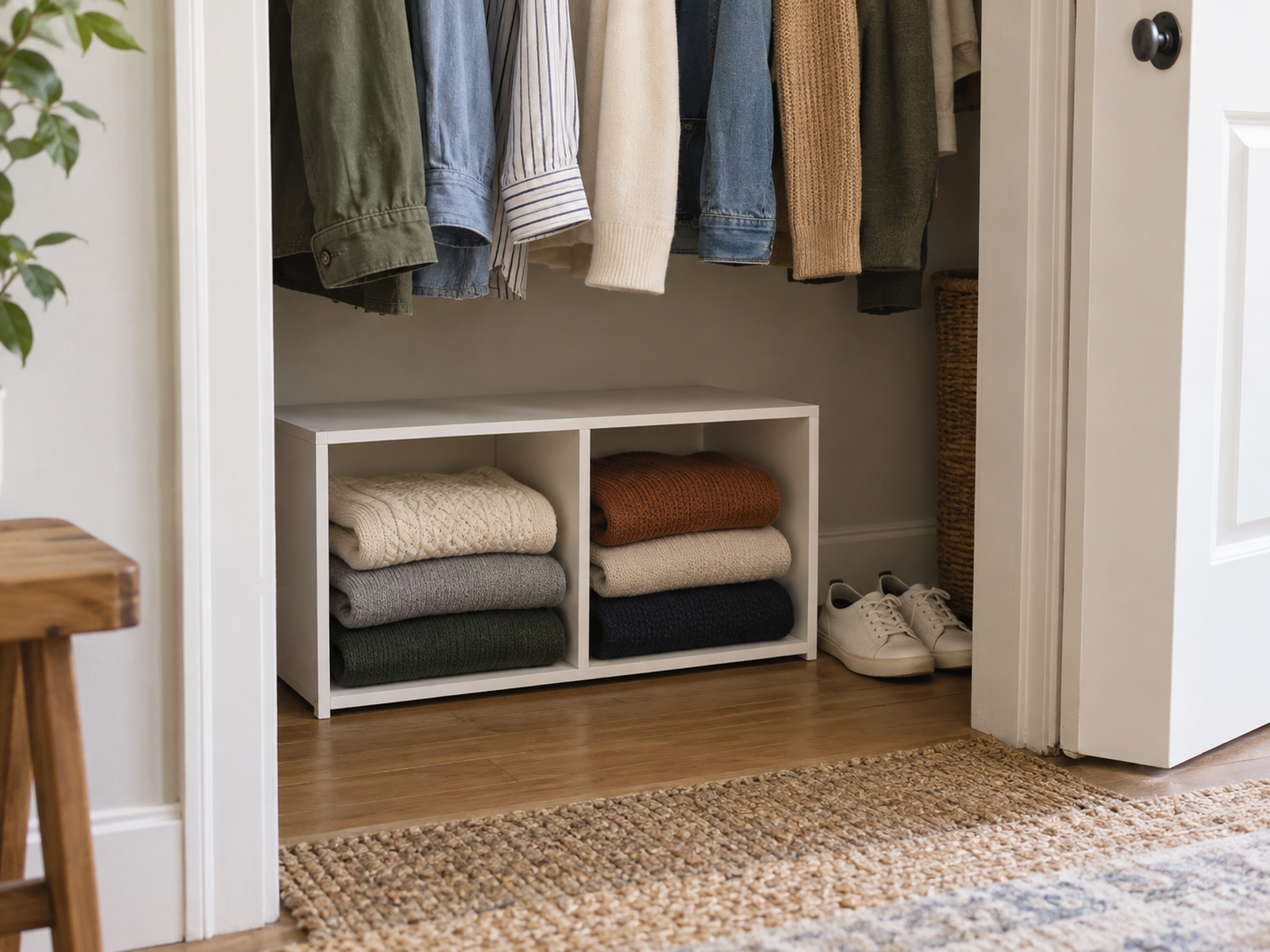
A low freestanding drawer, cube, or shelf unit can create a more dresser-like return path without sacrificing the hanging rod above it, provided the closet has a usable floor zone.
Place it under short-hanging garments or in an open side bay only when hems remain clear, drawers or bins can open fully, and sliding or hinged closet doors still operate normally.
The cost is shoe and floor capacity. A floor unit that forces footwear into the walkway or makes the closet too narrow to reach the back has simply transferred the shortage to another category.
Keep the unit removable when renter flexibility matters. Added wall tracks or built-in closet systems belong later in the decision order because fasteners, substrate, load, lease permission, and restoration obligations can all become part of the project.
06
Move Off-Season Sweaters Into Protected Secondary Storage
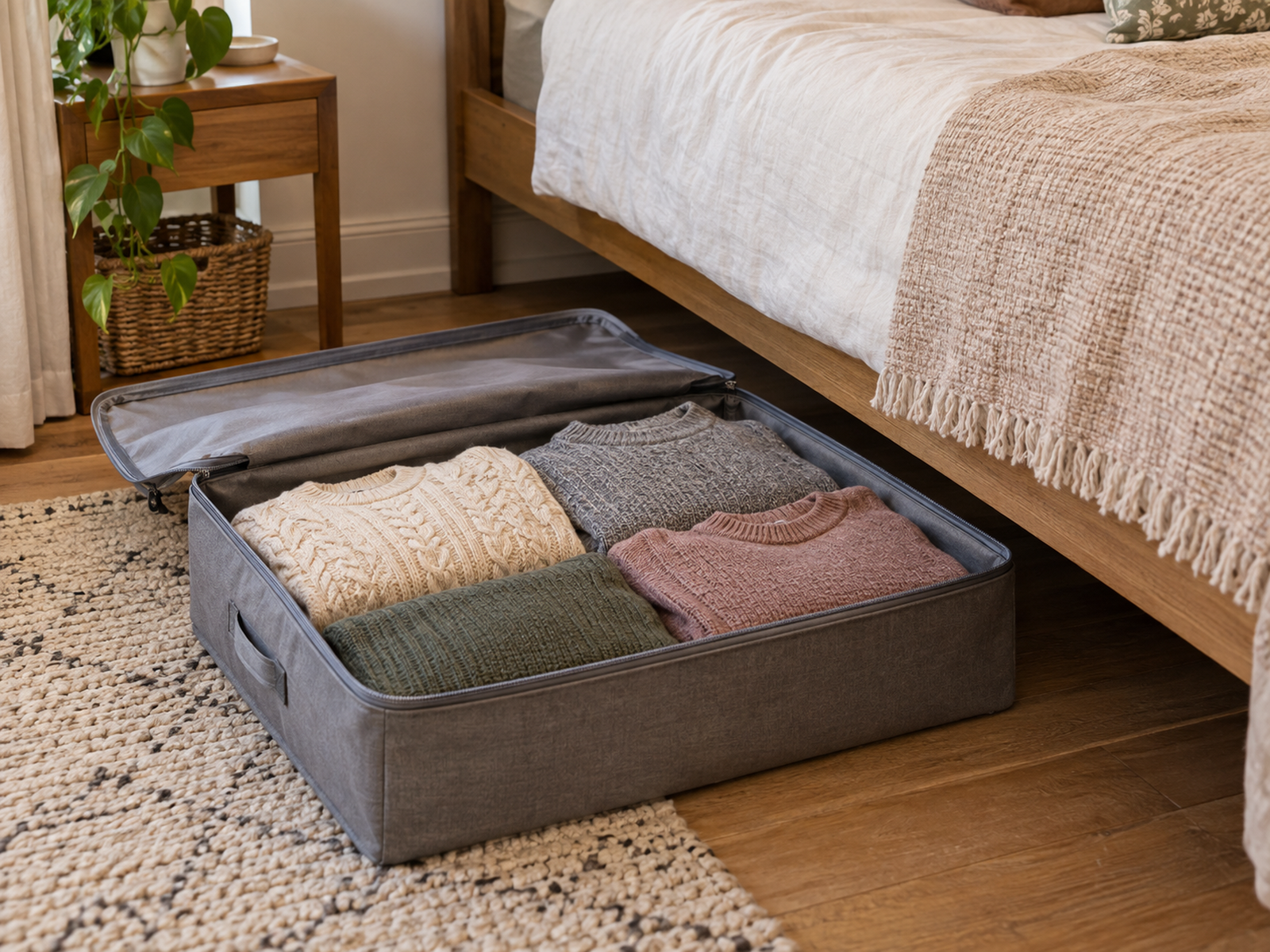
Once the active-season group has a workable home, move genuinely low-frequency sweaters out of prime closet space. Under-bed cases and secondary wardrobe storage are practical when the retrieval interval is seasonal rather than weekly.
For wool, Woolmark recommends cleaning garments before long-term storage and checking stored clothes periodically for moisture or insects. Store only clean, dry garments rather than sealing wear, soil, or dampness into a low-access container.
Breathable cloth storage can be a stronger choice for delicate knitwear when maximum compression is not the goal. Woolmark describes cotton or wool storage bags as safer for delicate clothing than vacuum packing because the garments can breathe.
Keep the boundary clear: that guidance is especially relevant to wool and delicate garments. Daily-access sweaters usually need a lower-friction open shelf, cubby, or drawer rather than a protective bag that must be opened and repacked every few days.
07
Treat Vacuum Compression as a Material-Sensitive Branch
Vacuum bags can reduce volume, but maximum compression is not automatically the best sweater-storage state. Woolmark notes that vacuum packing saves space while also limiting breathability, potentially trapping moisture, and being less suitable for delicate clothing.
That makes vacuum storage a conditional capacity tactic rather than the default seasonal answer. Delicate wool, cashmere, and unknown knit constructions should not be aggressively compressed simply because the closet is small.
For a robust garment whose own material and care guidance support compression, the trade may be acceptable in secondary storage. Keep the garment clean and dry first, and do not convert a general space-saving benefit into a claim that every sweater should be vacuum packed.
If the only way the wardrobe fits is by compressing delicate active-season sweaters all year, the underlying problem is still allocation. Move lower-frequency inventory farther out before forcing more density into the prime-access zone.
08
Make the Laundry Return Path the Final Test
A sweater system is not finished when the first organizing session looks neat. It has to survive the normal cycle of wearing, washing, drying, folding, choosing, and returning garments without a major reset.
Leave enough slack that one clean sweater can return without toppling a pile or displacing another category. If every cubby is packed to its exact volume, the next laundry load becomes an overflow problem immediately.
Visibility should match frequency. Keep active sweaters where labels, colors, or folded fronts can be read quickly; use less-visible bins and cases for seasonal inventory that does not need daily browsing.
If removable shelf, rod, floor, and secondary-storage options all fail, added shelving may be reasonable—but that is a structural and renter decision. Verify hardware, substrate, load, and permission instead of treating wall-mounted storage as the automatic next step.
Closing Decision
Protect the Sweater Without Breaking the Closet
The strongest sweater system does not try to make every garment equally accessible or compress every available inch. It protects shape-sensitive knitwear, gives the active-season group a visible folded home, and spends shelf, rod, or floor capacity only where that resource is genuinely cheaper than the alternatives.
Use the existing shelf when it works, convert rod width with a hanging cubby only when the closet can afford the trade, and move clean off-season sweaters into protected secondary storage. For delicate knitwear, treat compression cautiously, and let the laundry return path decide whether the system is actually sustainable.
RELATED GUIDES
What to Read Next
NEXT GUIDE
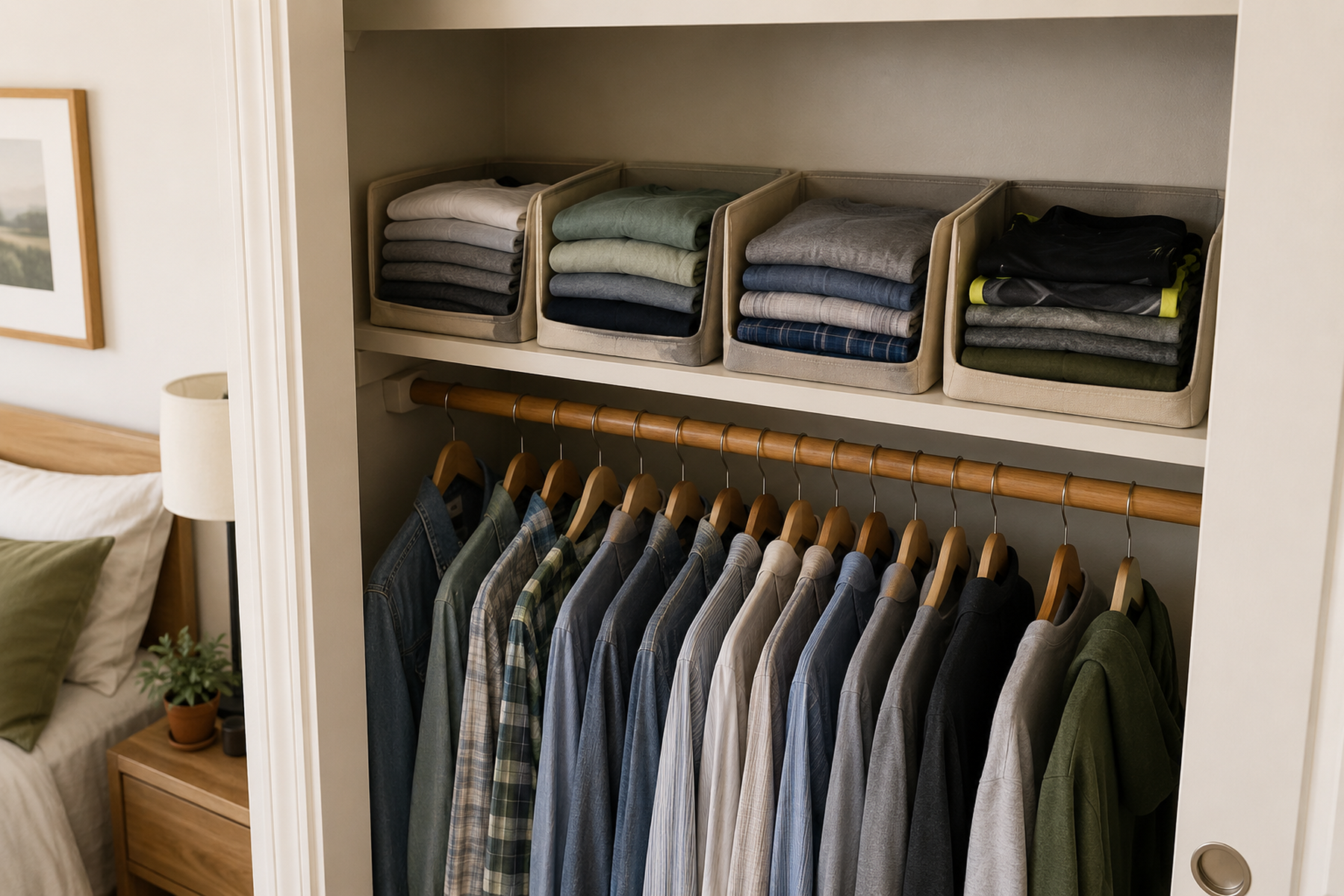
How to Store Folded Clothes in a Small Closet With No Dresser
Use this next if sweaters are only one part of the no-dresser problem; that guide handles the broader decision across shelf width, rod width, floor space, containment, and folded-clothing return paths.
GUIDE
How to Store Off-Season Clothes When Your Small Closet Has No Extra Space
Use this if seasonal rotation is the main capacity lever; that guide covers the broader off-season storage system beyond sweater-specific material and compression boundaries.
GUIDE
How to Organize a Small Closet With No Built-In Shelves
Use this if the closet starts as a rod-only shell; that guide focuses on creating renter-friendly storage planes before sweater-specific shape and seasonal decisions are layered in.