
Small Apartment Storage Ideas
How to Store a Window Air Conditioner in a Small Apartment With No Storage Closet
Decide whether the exact unit should come out before you hunt for a winter home, then prepare it by the manual, measure its upright footprint, and give the heavy reinstall kit the safest dry low zone the apartment can afford.
In This Guide
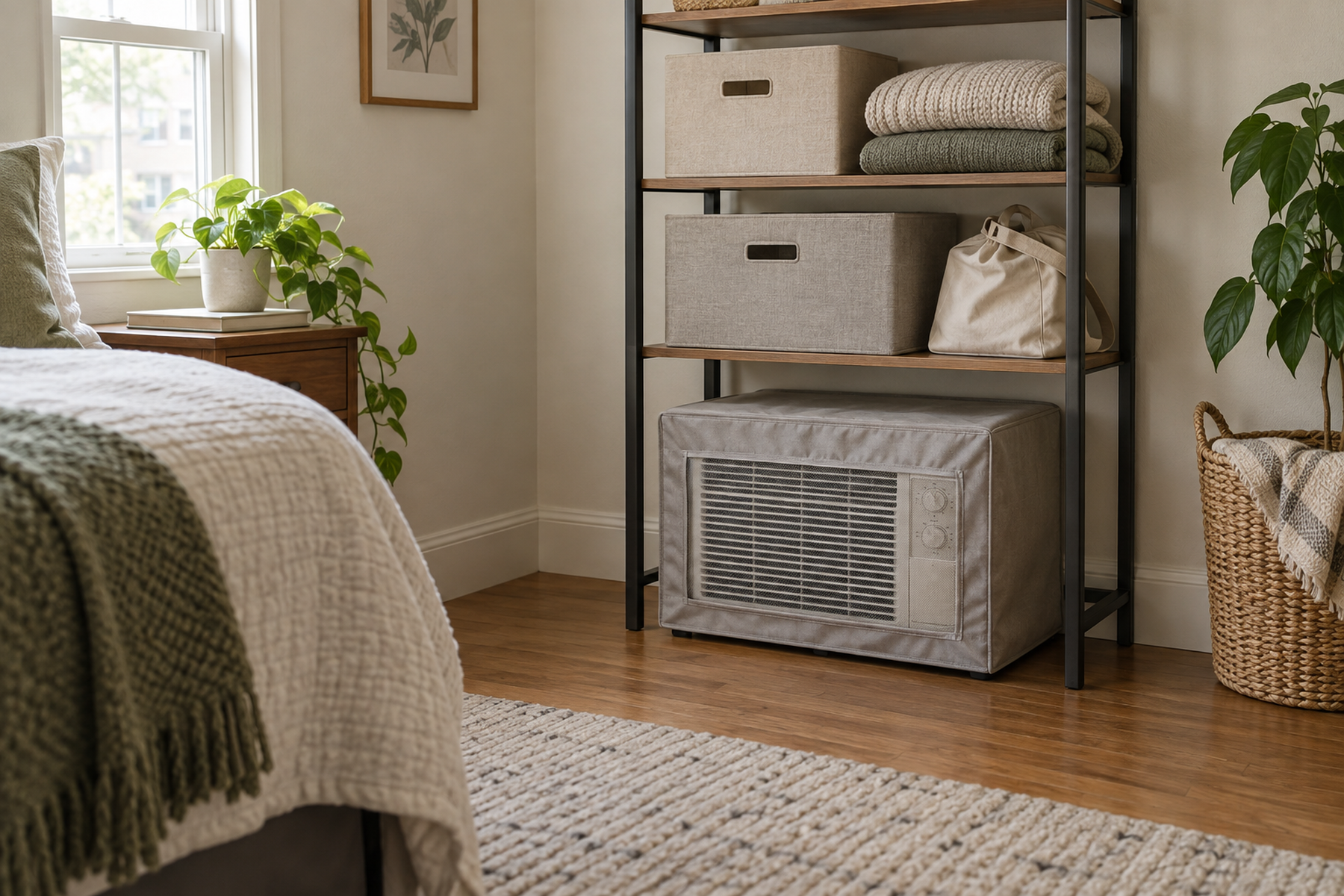
A window air conditioner saves interior floor space while it is cooling the apartment, then becomes a dense seasonal storage problem when the weather changes. If it comes out of the window, the unit may need to stay upright, dry, protected, and easy enough to retrieve without turning half the apartment into a moving project.
Do not start with the emptiest-looking corner. Check the exact model and building rules first, decide whether removal is realistic, then assign the appliance the safest low upright zone that can protect the unit and all of its reinstall parts until the next cooling season.
Quick Answer
Decide Whether Removal Is Worth the Storage Cost Before You Move the Unit
The real storage object is not just the A/C body. It is a heavy upright appliance plus its hardware, panels, remote, cover or carton, and the clear path needed to bring the whole kit back to the window next season.
01
Check the exact model and building rules first
Manufacturer guidance differs on winter removal, storage environment, drainage, drying, and restart procedures. Building or lease rules may also control who removes or reinstalls the unit.
02
Keep the appliance in its approved orientation
Frigidaire, GE, and Haier all support upright storage in current guidance. Do not turn an upright appliance sideways simply because under-bed or shelf storage would be easier.
03
Give the heavy object the safest low dry zone
Prioritize a stable, retrievable floor-level position over clever vertical storage, then move lighter seasonal categories to higher, flatter, or less protected locations if that trade makes more sense.
01
Decide Remove vs. Leave Installed Before You Hunt for Storage
There is no universal rule that every window A/C must come out each fall. GE currently says winter removal is not necessary in every case, while Haier more strongly recommends protected winter storage for window units.
That makes storage capacity part of the technical decision. Removing the unit can recover the window and move the appliance away from winter exposure, but it also creates a heavy indoor object that may occupy scarce floor or closet volume for months.
Leaving the unit installed can be a rational small-apartment fallback when manufacturer guidance and building rules allow it and the apartment has no credible storage zone. That branch still needs the exact model’s winter-care instructions rather than an improvised cover or sealing method.
Before planning a storage location, confirm the owner or installation guidance, check any building or lease requirements, and decide whether the seasonal lifting cycle is realistic for this unit and this window.
02
Prepare the Exact Model Before It Becomes a Storage Object
A removed window A/C should not go straight from the window into a corner. Used units can retain water, dust, and installation parts that need to be handled according to the exact model before long-term storage.
GE warns that a used room air conditioner may contain water and cautions against simply tipping the unit during removal. Haier’s current storage guidance includes draining, fan-mode drying, filter cleaning, cord storage, remote-battery handling, hardware collection, and upright dry storage.
Those details are evidence for a preparation stage, not a universal recipe. Drain locations, drying instructions, cover methods, and restart procedures can vary by model, so follow the manual instead of borrowing a procedure from another brand.
Finish the reset before the appliance disappears into storage. A clean, dry, prepared unit with its cord controlled and its loose parts accounted for is much easier to store safely than an A/C that still needs seasonal maintenance six months later.
Measure / Check First
Before committing a winter storage zone, verify the exact model, the approved orientation, and the full path the appliance must travel twice each year.
Check Model Guidance, Upright Fit, and the Retrieval Route First
01
Model and building requirements
Confirm the exact removal, drainage, drying, storage, and winter-care guidance for the unit, then check whether the landlord, co-op, condo, or building controls removal or reinstall work.
02
Upright stored footprint
Measure the A/C in its approved storage orientation, including any carton or cover you plan to keep. Reject locations that only work by laying the unit on a prohibited side or by putting it on an unverified high shelf.
03
Controlled movement and next-season retrieval
Trace the route from the window to storage and back. Include door openings, turns, furniture, stairs, unit weight, and the need for help so the plan does not depend on an improvised lift.
If the only available location is damp, requires prohibited orientation, depends on an unverified elevated surface, or creates an unrealistic lifting and retrieval path, reconsider removal or use a different storage class before moving the unit.
03
Measure the Upright Footprint and Retrieval Path
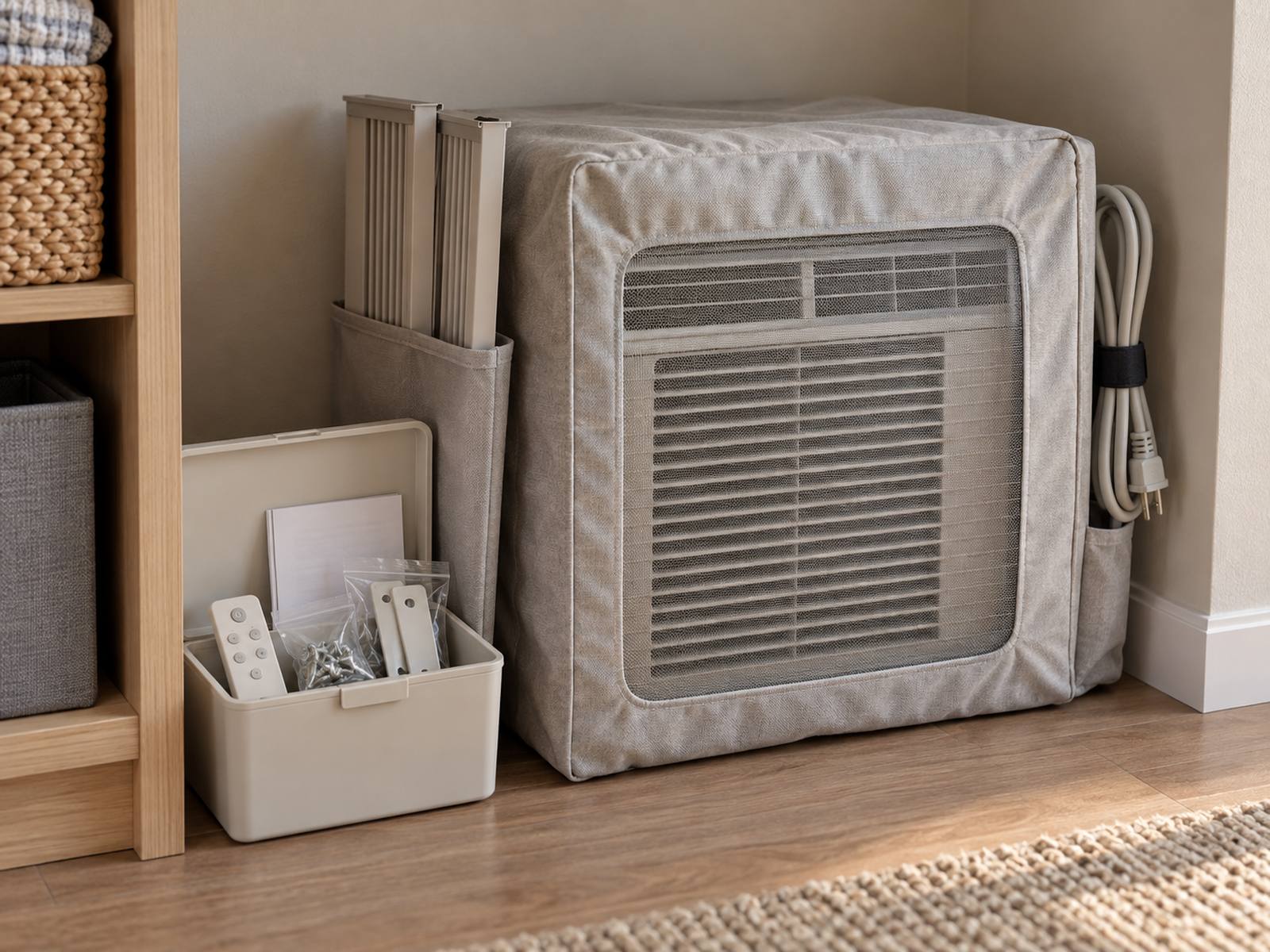
Measure the appliance in the orientation the manufacturer allows for storage. Multiple current manufacturer sources support keeping window units upright, which immediately rules out some otherwise tempting small-apartment locations.
Under-bed space may have enough horizontal area but still be the wrong geometry if the unit would need to lie on its side. A narrow upper shelf can have enough volume but still create an unsafe or unrealistic lifting path for a dense appliance.
Measure the opening and the route as well as the final footprint. A closet floor or room corner is not useful if the A/C only fits after being rotated through a doorway in a prohibited orientation or after fragile furniture is moved out of the way.
Plan the next removal from storage before committing to the location. Seasonal storage should let the unit travel back toward the window upright and controlled, without unpacking the entire apartment first.
04
Give the Heavy Appliance the Safest Low Dry Zone
A window A/C is a poor candidate for storage density tricks. Even a current compact 5,000 BTU Midea example weighs about 35 pounds, and larger models can be substantially heavier.
That does not create a universal lifting threshold, but it does change storage priority. A low floor zone is usually more believable than the top of a wardrobe, high shelf, or unstable furniture surface because seasonal retrieval does not begin with an overhead lift.
The environment matters as much as the dimensions. Frigidaire emphasizes dry storage and cautions about garage or basement floor moisture, GE allows some non-heated storage when the unit remains upright, and Haier recommends climate-controlled winter storage.
Use the exact manufacturer guidance to decide whether a secondary storage room, basement, garage, or other space is acceptable. A location can fit the A/C perfectly and still fail because it is damp, leak-prone, unstable, or too difficult to retrieve.
05
Treat the Original Carton as Optional Capacity
Original packaging can protect the appliance and keep foam, panels, remote, and mounting hardware together, but the box can also make an already bulky object larger.
Frigidaire and Haier both support original-carton or covered-storage approaches in current guidance. That makes the carton useful when its protection and part-control value justify the extra footprint, not a universal requirement.
Measure the stored dimensions with the carton before deciding to keep it. If the box eliminates the only viable low upright zone and the manufacturer allows a cover instead, the packaging may be costing more apartment capacity than it saves.
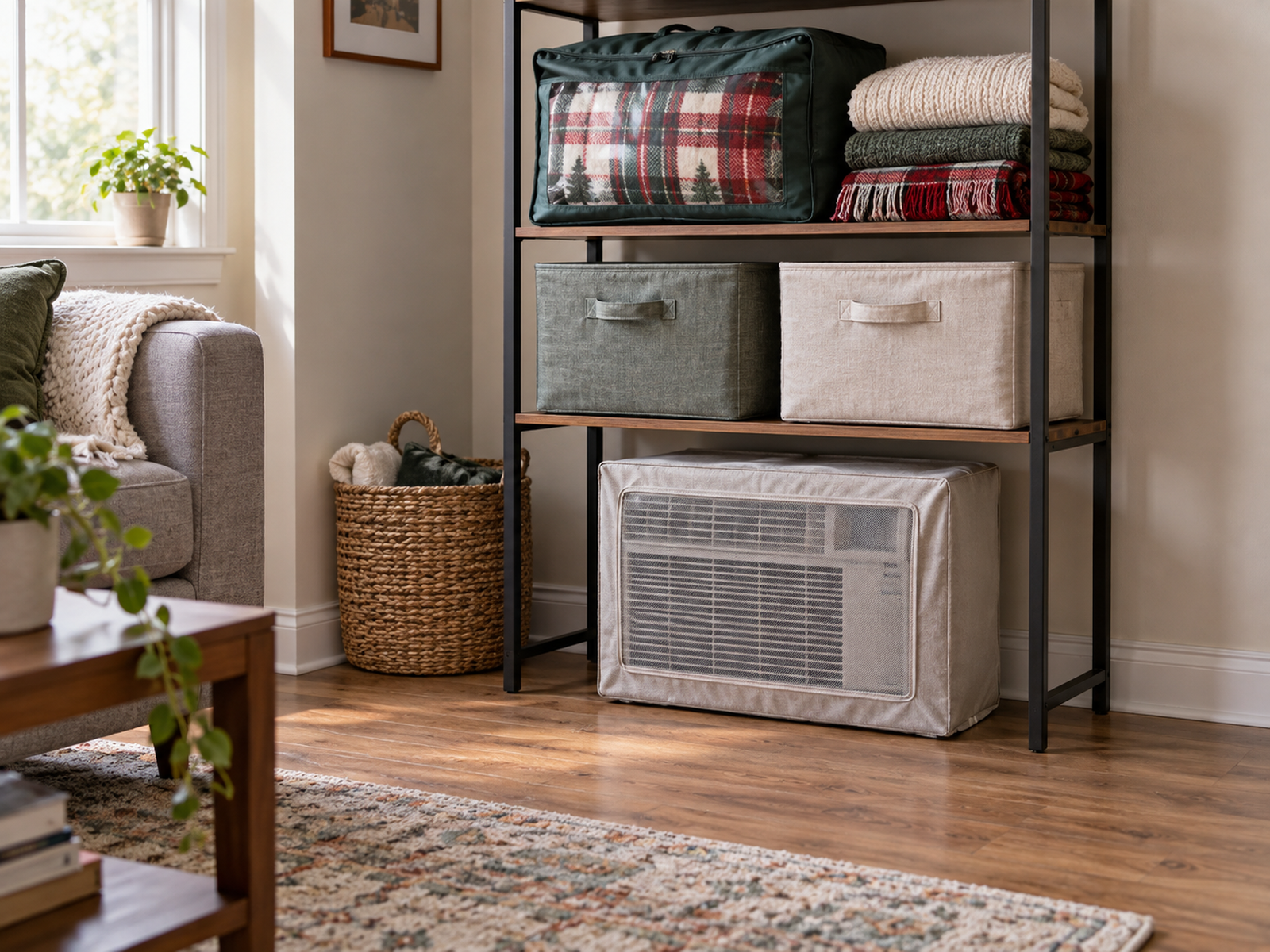
If the carton is discarded, replace its organizational job deliberately. Use a protective cover permitted by the manufacturer and keep the small installation components in a bounded container that stays physically with the appliance.
06
Store the Reinstall Kit Together
The useful seasonal storage object is the A/C plus everything needed to put it back into service. Haier specifically advises gathering window mounting hardware when the unit is stored.
Keep side panels, brackets, screws, seals or foam, remote, drain parts, model-specific accessories, and the manual or model-number reference with the appliance rather than letting them migrate into general hardware drawers.
Use one small lidded parts box, pouch, or original accessory compartment that can stay on top of, beside, or securely associated with the covered unit without creating a tipping or lifting problem.
This is less about neatness than next-season reliability. A perfectly protected air conditioner is not truly ready for storage if reinstall day begins with a search for the missing bracket, remote, or side panel.
07
Use Building or Off-Site Storage Only When the Apartment Hits a Real Limit
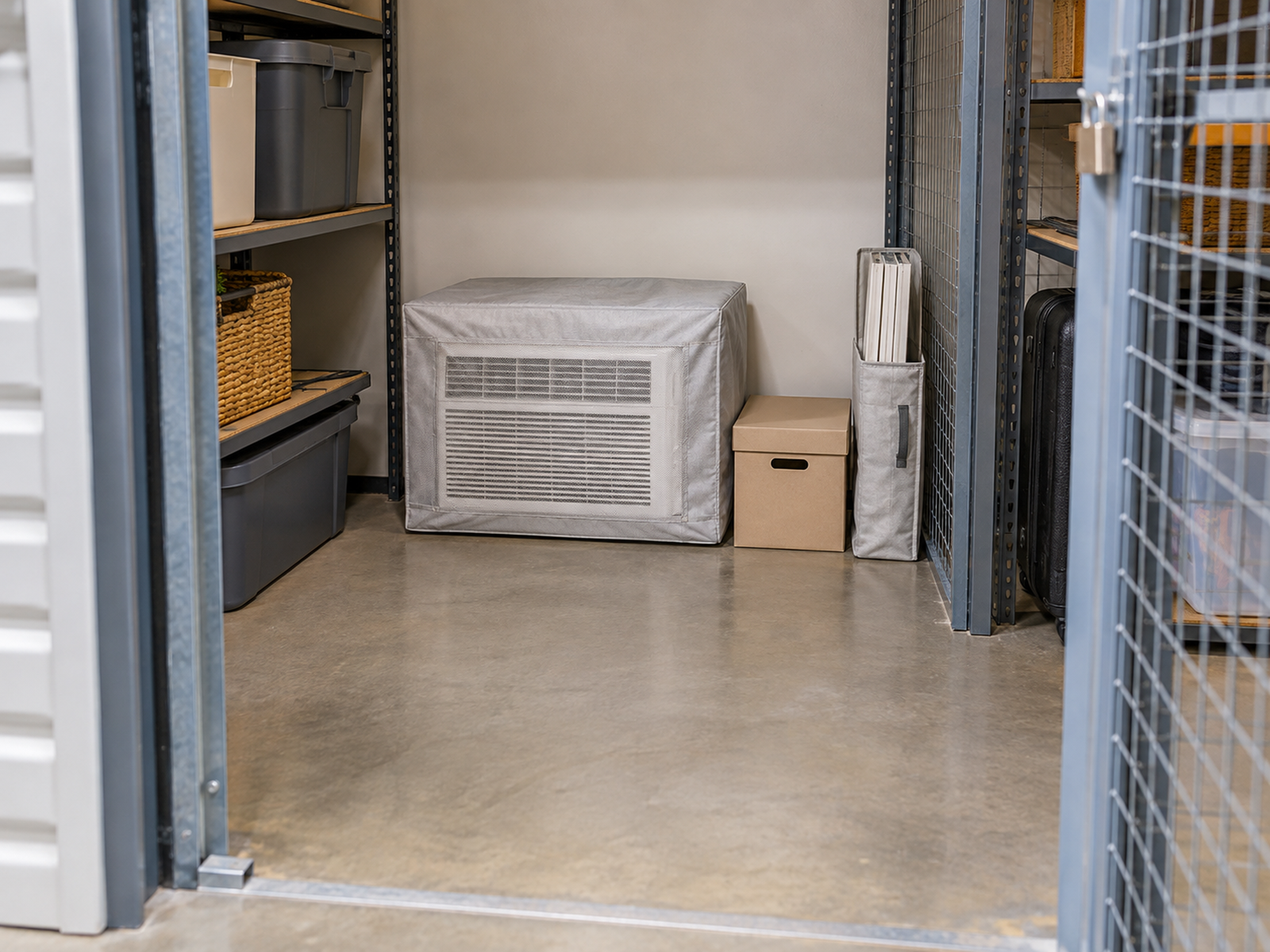
If no dry upright zone exists inside the apartment, a building storage room, storage locker, or paid seasonal service can outsource the footprint instead of forcing the unit into an unsafe position.
The environment still has to pass. Do not assume a basement, garage, or storage room is suitable simply because it is outside the living area; moisture, temperature, flooding, security, and the exact manufacturer’s guidance still matter.
Paid seasonal storage can be rational when the alternative is surrendering a large percentage of usable apartment floor space, but it adds recurring cost, scheduling, and third-party handling. There is no standard price or universal economic break-even point established for that choice.
Use this branch after the apartment has reached a real capacity limit, not automatically. If the unit can live safely in one low secondary zone without displacing daily-use categories, keeping the system in-house may remain simpler.
08
Preserve the Next-Season Return Path
Off-season storage is successful only if the A/C can come back out as predictably as it went in. Do not bury a guaranteed seasonal item behind categories that will have to be completely unloaded before summer.
Keep the unit upright through retrieval, preserve a route wide enough for controlled movement, and avoid storing fragile items directly in the path that the appliance has to travel.
If the A/C displaced lighter seasonal items, document that storage swap in the room rather than relying on memory. Holiday décor, empty luggage, or soft goods can often tolerate higher, flatter, or more remote zones that are unsuitable for a dense orientation-sensitive appliance.
Before reinstalling, return to the exact model and building instructions. The purpose of winter storage is to preserve the appliance and the apartment, not to turn the next hot week into an emergency hardware hunt or an unsafe lift.
Closing Decision
Give the A/C the Safest Boring Zone, Then Move Lighter Things Around It
A window air conditioner is not ordinary seasonal clutter. It is rigid, dense, orientation-sensitive, and tied to model-specific preparation and reinstall hardware, so the best storage location may be the least clever one: a dry, stable, low upright zone with a clean route back to the window.
If the apartment cannot provide that zone, leaving the unit installed when the exact guidance and building rules permit it or outsourcing the footprint can be more sensible than forcing a false storage fit. Protect the appliance, keep the reinstall kit together, and let lighter, more flexible seasonal categories absorb the awkward shelves, upper zones, and flatter spaces instead.
RELATED GUIDES
What to Read Next

NEXT GUIDE
How to Store Holiday Decorations in a Small Apartment With No Storage Closet
Use this next if the A/C is competing with other seasonal categories for the same off-season capacity; that guide focuses on storage budgets, packed shape, and moving lighter seasonal items into secondary-access zones.
GUIDE
How to Store Suitcases in a Small Apartment With No Storage Closet
Use this if luggage is occupying the low closet or room zone the A/C needs; that guide helps reassign bulky but more orientation-flexible items by access frequency and available geometry.
GUIDE
How to Store a Broom, Mop, and Vacuum in a Small Apartment With No Utility Closet
Use this if cleaning tools and appliances are competing for the same floor or closet edge; that guide focuses on retrieval, equipment-specific constraints, and renter-friendly storage without a utility closet.