
Small Apartment Storage Ideas
How to Store Worn-Once Clothes in a Small Apartment
The clothes chair is usually doing a job the room never planned for. Give rewear clothes one small, visible holding zone with a clear capacity and a clear exit.
In This Guide
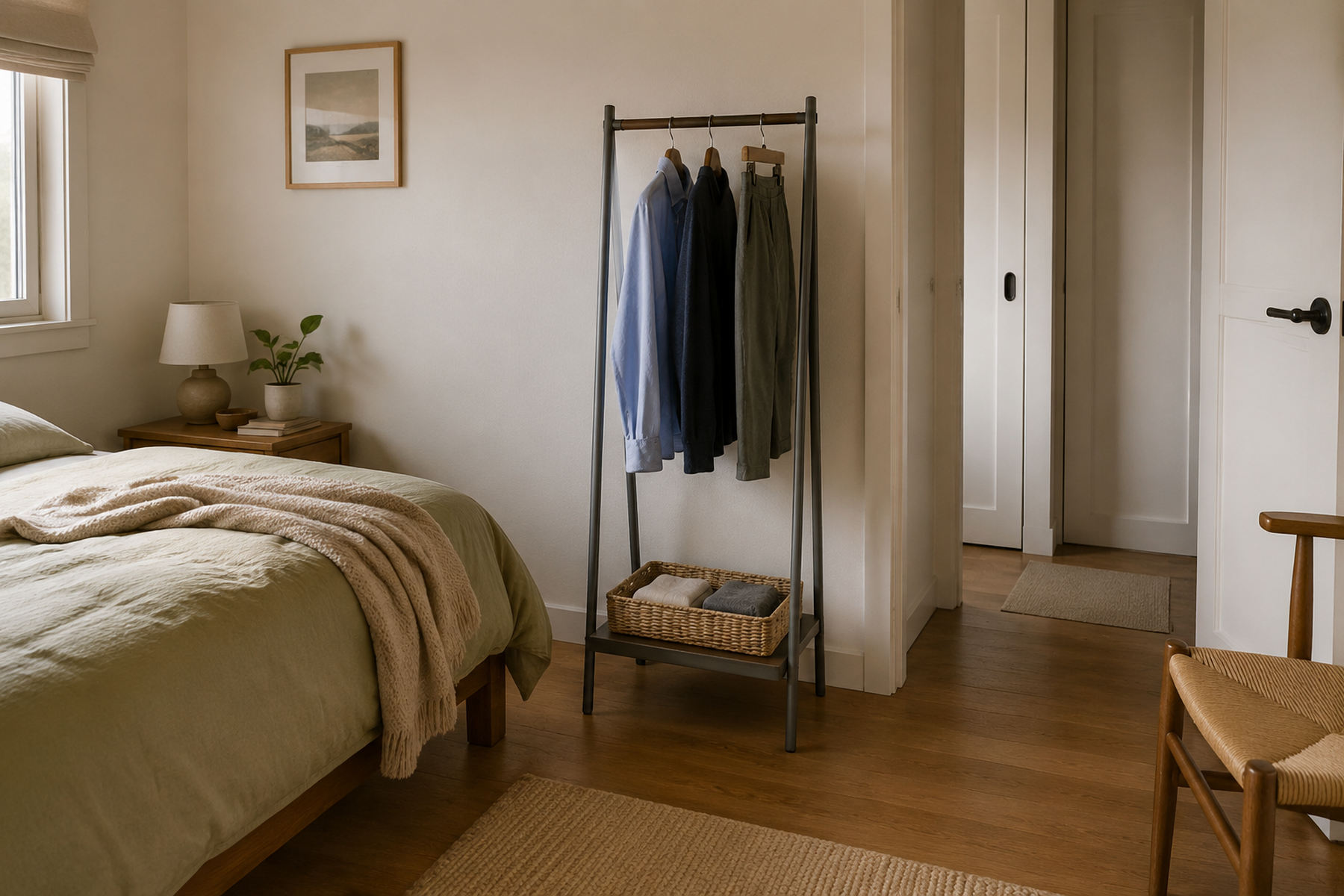
Most bedrooms are organized for two clothing states: clean clothes go back to the closet or dresser, and dirty clothes go to the hamper. Real routines often create a third state—clothes you have already decided are not going to laundry yet and expect to revisit soon.
When that temporary state has no address, the nearest low-friction surface becomes the system: a chair, the bed, a dresser top, a door handle, or the floor. The fix is not necessarily more clothing storage. It is a small rewear zone that matches the way garments are handled, stays visible enough to process, and has a built-in reason to empty.
Quick Answer
Build a Small Rewear Zone, Not a Second Wardrobe
Treat worn-once clothes as a temporary third category between clean storage and laundry: give them one deliberately small rewear zone, keep its capacity finite, and use a clear reset trigger so it empties before becoming a second wardrobe.
01
Name the third state
Decide what the zone is for before choosing an organizer: short-term rewear items that are waiting for another decision, not clean-laundry overflow or dirty-laundry overflow.
02
Give it the smallest useful capacity
Use enough room for the household’s real in-between volume, not enough room to become a second wardrobe. A finite zone makes it obvious when the temporary category needs attention.
03
Design the exit before the zone fills
Choose what prompts the next decision: a normal laundry cycle, a recurring bedroom reset, or simply the physical limit of the zone. Temporary storage needs a way out.
01
Define What Counts as the Rewear Zone
Start with the storage state, not the product. The rewear zone is for clothing the household has already decided is not going to laundry yet and expects to revisit soon. It is not a universal judgment about how many times a garment should be worn.
Keep that boundary separate from clean laundry, dirty laundry, and long-term wardrobe storage. Tomorrow’s outfit can also be a short-term clothing state, but it should not disappear into the same pile without a clear distinction.
Garment-care decisions still belong to the garment and its instructions. The U.S. Federal Trade Commission’s Care Labeling Rule requires regular-care instructions on covered garments; this guide is about where an item waits after you have already made the decision not to send it to laundry yet, not about overriding those instructions.
02
Size the Zone From the Real In-Between Volume
The clothes chair feels spacious because it has elastic capacity: one garment becomes three, then the backrest, seat, and floor all become part of the same temporary zone. A useful rewear system should make that growth visible rather than accommodate it indefinitely.
Look at the busiest point in the normal routine, not the neatest day. If the in-between category is usually a pair of jeans, a hoodie, and one work layer, the system does not need the capacity of a garment rack built for half a wardrobe.
A small capacity is a feature here. When the hooks, rail section, basket, or valet zone is full, the next move should be a decision about what stays in rotation, what returns to clean storage if appropriate for the household, and what goes to laundry—not the creation of a second rewear pile.
03
Match the Storage Form to the Way the Garment Waits
Use hanging storage when individual visibility matters and the garment is naturally handled on a hanger or hook. A few hooks, a short rail, or a compact valet-style zone lets each item remain identifiable instead of being buried under the next one.
Use a small open basket or shallow shelf zone for folded or soft items that can be placed and retrieved without digging. The basket should be easy to inspect; a deep lidded container can turn temporary clothing into forgotten clothing.
Do not force every rewear item into the same format. The useful question is whether the next action is easier when the item stays individually visible or when it sits in a small contained folded zone.
Measure / Check First
Before adding hooks, a basket, a ladder, or a rack, test the way the room and the clothing actually behave. A solution that fits while empty can fail as soon as garments are added.
Test the Storage Plane in Its Real Loaded State
01
Check the natural landing path
Place the zone close enough to where clothes actually come off that it can beat the chair, bed, or floor. Convenience is part of the storage system.
02
Check operation with real garment bulk
If the zone uses a door or wall edge, test opening, closing, wall contact, nearby furniture, and how far the loaded garments project into the room.
03
Check the return and exit path
Make sure each item can be added, identified, removed, and processed without moving another organizer or rebuilding a pile.
There is no universal hook count, basket volume, door clearance, or reset schedule. Size the zone from the household’s real temporary inventory and the exact room geometry.
04
Use a Closet Sub-Zone When the Closet Can Spare It
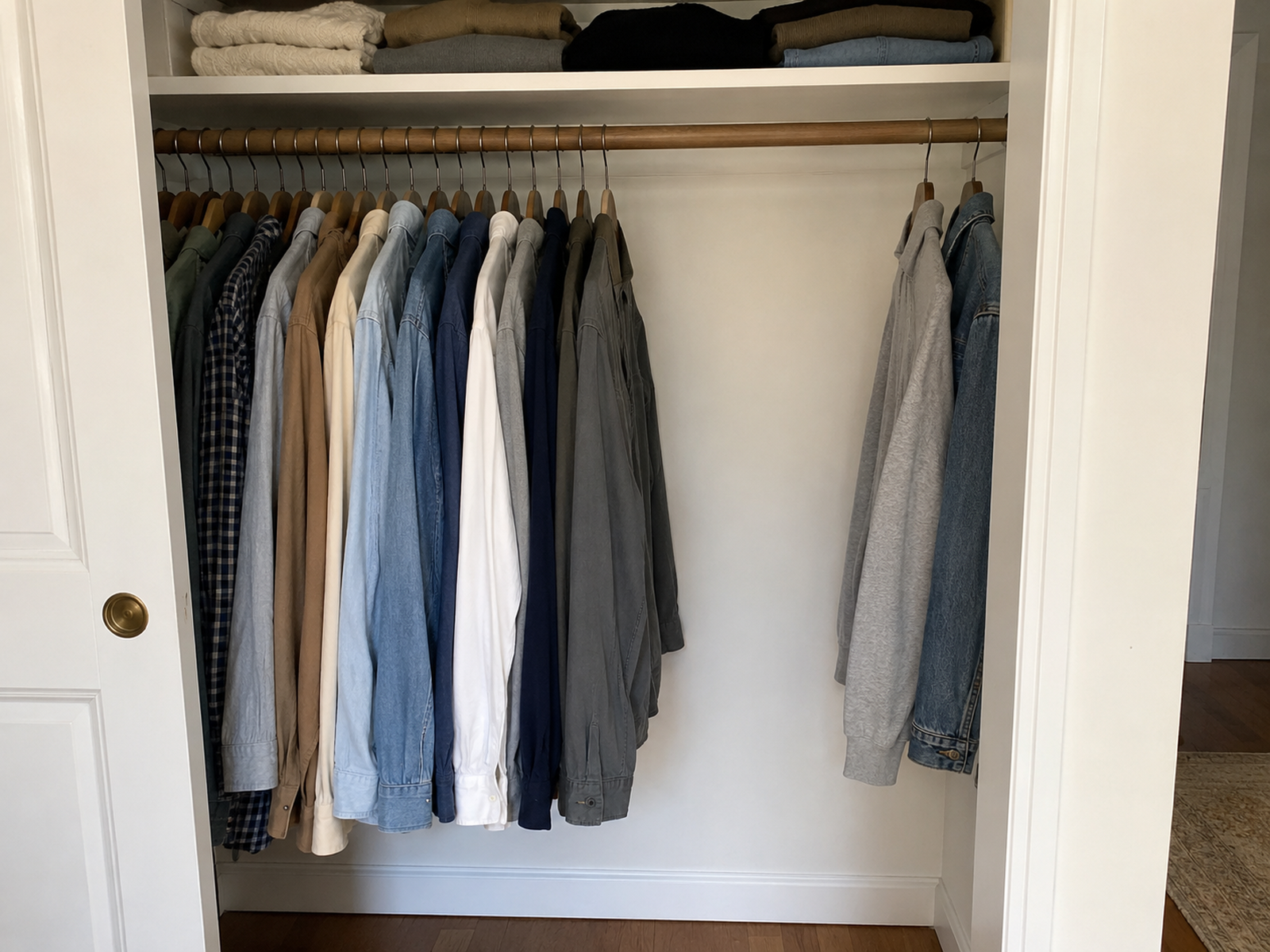
The closet is often the lowest-footprint place to create a rewear zone because the room already treats it as clothing territory. One hook, a short rail segment, or a visibly separated group of hangers can create the temporary state without adding furniture.
The trade is closet capacity. If the rod is already packed or the user strongly prefers not to mix worn and fully clean clothing, forcing the rewear zone inside the closet can make the permanent wardrobe system worse.
Keep the boundary obvious. A small physical gap, one dedicated end of the rod, or another simple visual separation is more useful than letting rewear items drift through the clean wardrobe.
05
Use the Door or Wall Only After You Test the Loaded State
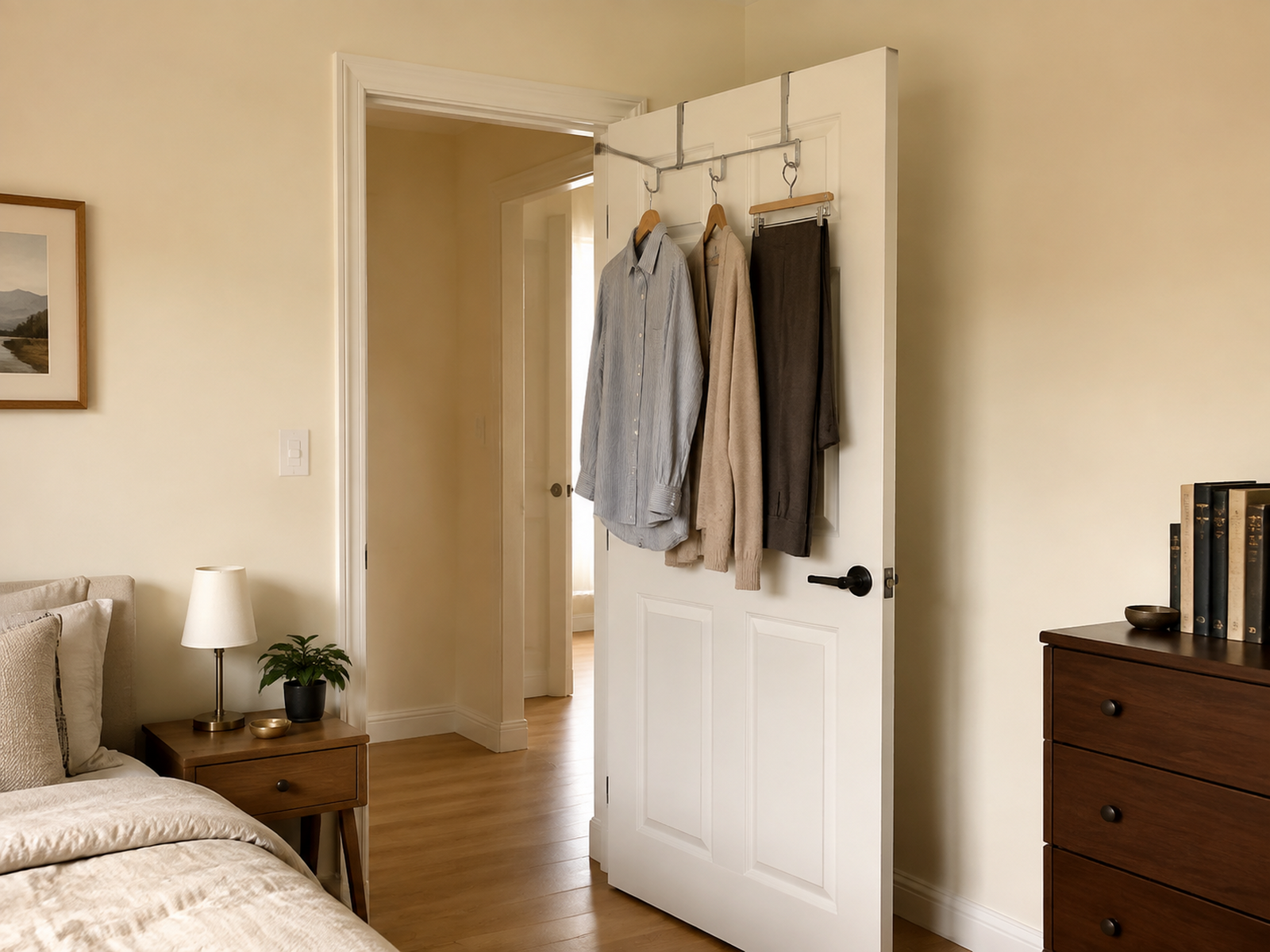
Door-back storage is powerful in a small bedroom because it can create hanging capacity without spending floor area. But the door is an operating surface, not blank real estate: thickness, top gap, swing, wall clearance, and garment projection all matter.
For example, Yamazaki’s current Smart Over-The-Door Hook lists a specific compatible door-thickness range and product-specific load. That is a useful reminder that “over-door” is a fit category, not a universal promise.
Wall hooks require the same exact-product discipline. A self-adhesive hook may avoid drilling, but that does not make removal risk disappear: IKEA’s current SKOGHALL self-adhesive hook warns that the adhesive tape can leave marks when removed. A screw-mounted folding hook such as KLYKET is compact when empty, but the manufacturer requires secure anchoring. Use the exact surface, load, removal, and installation instructions rather than assuming “adhesive” or “small” automatically means renter-safe.
Use / Skip
When Over-Door Storage Is the Right Rewear Plane
Use — Choose it when the door has compatible thickness and top clearance, the loaded garments do not interfere with the swing, and a small hanging zone near the undressing path solves the problem without using floor space.
Skip — Choose another plane when the door hits a wall or furniture, the garments block closure, the top gap is too tight, or the door is already a high-use surface that becomes annoying when clothing is added.
06
Spend Floor Space Only When It Replaces a Worse Footprint
A leaning ladder, slim valet, small rack, or open basket can be completely removable and still cost valuable floor area. Compare that footprint with the space the current pile is already consuming instead of calling every freestanding solution “space-saving.”
A leaning ladder is a good example of the trade. Yamazaki’s current Tower Leaning Ladder uses no fixed installation under its stated setup, but the product still projects onto the floor and has product-specific load limits. Low intervention is not zero spatial cost.
Floor-based storage earns its place when it makes garments easier to see and return while keeping the bed exit, closet, door, and main walking path clear. If a new rack takes more usable room than the clothes chair did, it has solved the appearance of the pile without necessarily improving the room.

What Not to Do
Don’t Turn the Rewear Zone Into a Bigger, Better-Hidden Pile
A large hamper, deep basket, or full-size garment rack can make the bedroom look calmer on day one while giving temporary clothing enough capacity to accumulate for weeks. The goal is not to hide as much as possible; it is to keep a short-term category easy to see and easy to process.
Do not add a second rewear container when the first one fills. Treat capacity as information. A full zone means the temporary category has reached the point where the next decision should happen.
07
Give the Rewear Zone a Clear Exit Trigger
Temporary storage fails when entry is effortless but exit never happens. The rewear zone should have one predictable moment that forces a decision before it turns into semi-permanent wardrobe overflow.
That trigger does not need to be the same for every household. It can be the normal laundry cycle, a chosen bedroom reset, or the moment the physical zone reaches capacity. The principle matters more than the schedule.
Keep outfit staging distinct if it shares the same area. Tomorrow’s clothes need immediate morning access; rewear clothes are waiting for a later decision. A short rail or hook group can support both only when the two states remain visually separate and easy to clear.
Decision Sequence
Choose the Lowest-Conflict Rewear Zone
01
Start with existing clothing territory
If a small, clearly separated closet subsection works, use it before adding another object to the bedroom.
02
Use the door when it passes the loaded-state test
Over-door storage can protect floor area, but only when the exact door and garment projection still allow normal operation.
03
Use a small open floor zone when it genuinely earns the footprint
A basket, valet, or leaning ladder can work when it replaces a worse pile and stays outside circulation.
04
Escalate wall attachment only with exact compatibility
For adhesive or screw-mounted options, follow the exact surface, removal, load, installation, and lease requirements rather than relying on generic renter-friendly labels.
Closing Decision
Give Temporary Clothes a Temporary Home
The clothes chair is often a signal that the room has no place for a real third clothing state. You do not need to moralize the pile or build a second wardrobe around it. Create one small zone that matches the garments, sits close to the existing routine, and has a capacity you can see.
The best rewear zone is the one that is easier to use than the chair and easier to empty than a pile. Keep the category finite, keep the next action visible, and let the storage plane earn its space.
RELATED GUIDES
What to Read Next
NEXT GUIDE
How to Store Off-Season Clothes When Your Small Closet Has No Extra Space
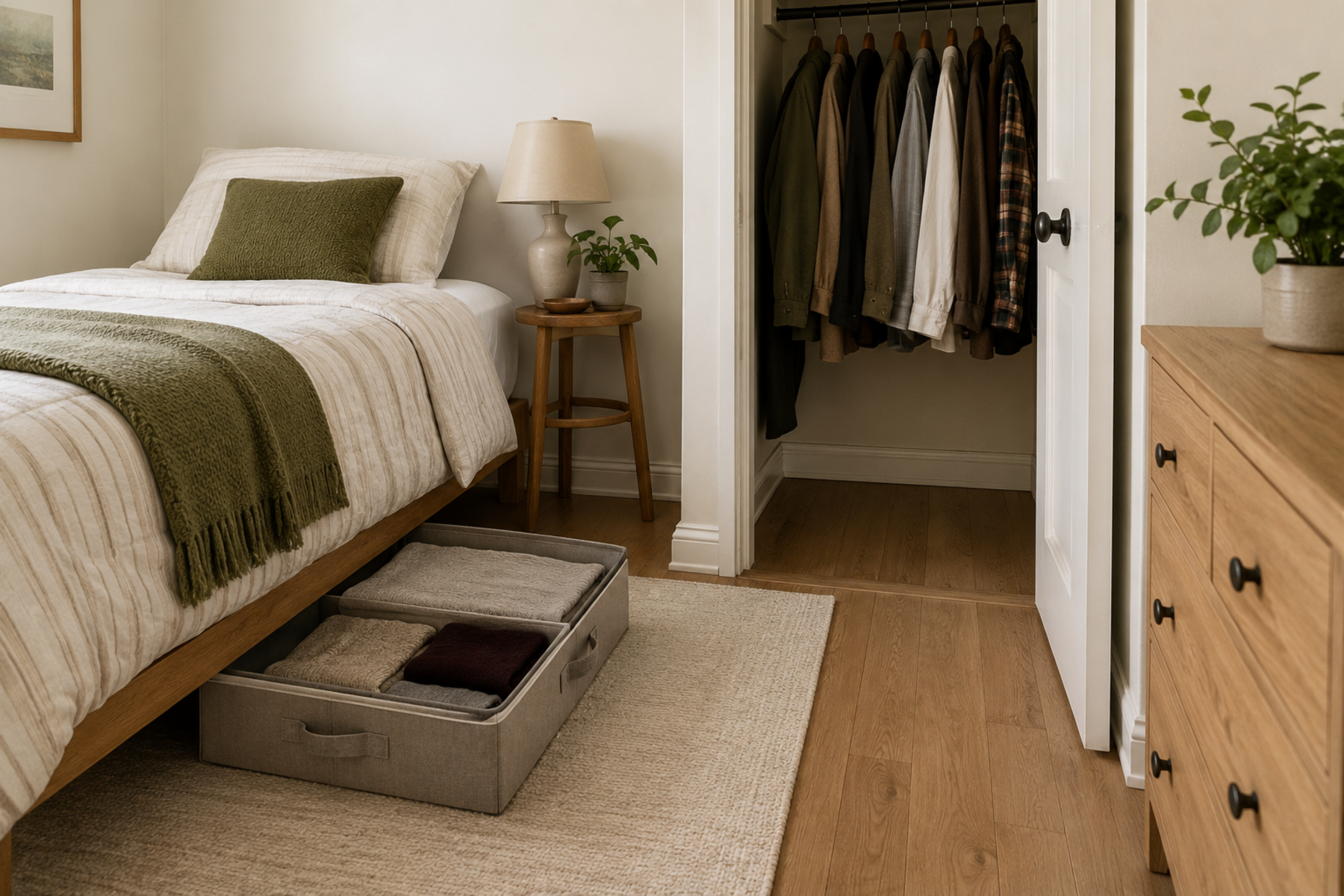
Useful for separating another lower-frequency clothing category from the active wardrobe without consuming prime access space.
GUIDE
How to Store Folded Clothes in a Small Closet With No Dresser
Continues the clothing-storage problem when folded items also have to live inside the closet.
GUIDE
How to Make Room for Long Dresses and Coats in a Small Double-Hang Closet
Useful when hanging geometry, rather than rewear frequency, is the next wardrobe-space constraint to solve.