
Small Kitchen Organization
Can You Store Things on Top of a Refrigerator in a Small Kitchen?
The top of a refrigerator can look like free storage in a small kitchen, but it is appliance-adjacent space first. Check the exact refrigerator manual, preserve required clearance and ventilation, then decide whether any remaining area is safe enough to reach, clean, and use for low-frequency storage.
In This Guide
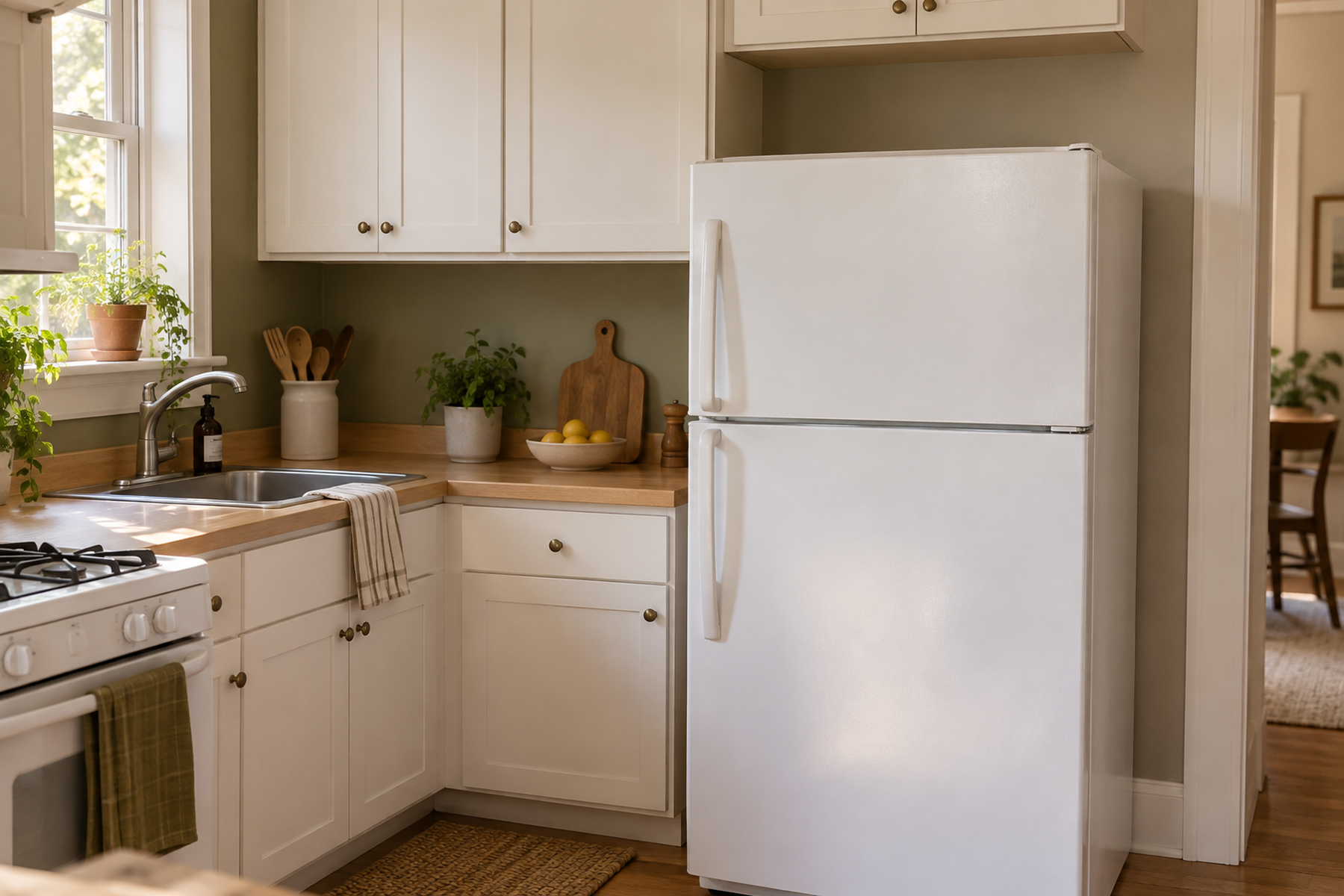
The empty-looking space above a refrigerator is not automatically storage volume. The refrigerator may require top clearance for installation or ventilation, and some model documentation explicitly warns against storing articles on top.
Even when storage is permitted, the zone still has to pass a second test: can you see, grasp, remove, return, and clean around the item without unsafe reaching or turning the refrigerator top into a forgotten catch-all?
Quick Answer
Subtract the appliance zone first
Do not start with a basket or storage category. Start with the refrigerator model and its documentation, then count only the space that remains after required clearance and restrictions are respected.
01
Read the exact manual
Find the model number, installation instructions, required clearances, ventilation guidance, and any warning about storing objects on top.
02
Test the remaining space
Measure only the height and area left after the required appliance zone is preserved.
03
Test the human access
Use the zone only when permitted items are stable, low-frequency, easy to grip, and safely reachable for retrieval and cleaning.
01
Check the refrigerator manual first
Top-clearance guidance is not universal. Current manufacturer guidance illustrates the variation: GE commonly publishes about 1 inch of top air clearance, Whirlpool currently publishes 1/4 inch in referenced general placement guidance, and Samsung publishes at least 3/8 inch in referenced installation guidance while also emphasizing additional ventilation space in other current guidance.
Those numbers are examples, not a rule to average or choose between. The exact model’s installation instructions control.
The manual can also change the answer completely. Current Dacor/Samsung documentation for specific refrigerators says to keep ventilation openings clear and warns not to store articles on top because they may fall when doors open or close. When the exact refrigerator prohibits top storage, the useful direct-on-top storage capacity is zero.
02
Subtract the appliance zone
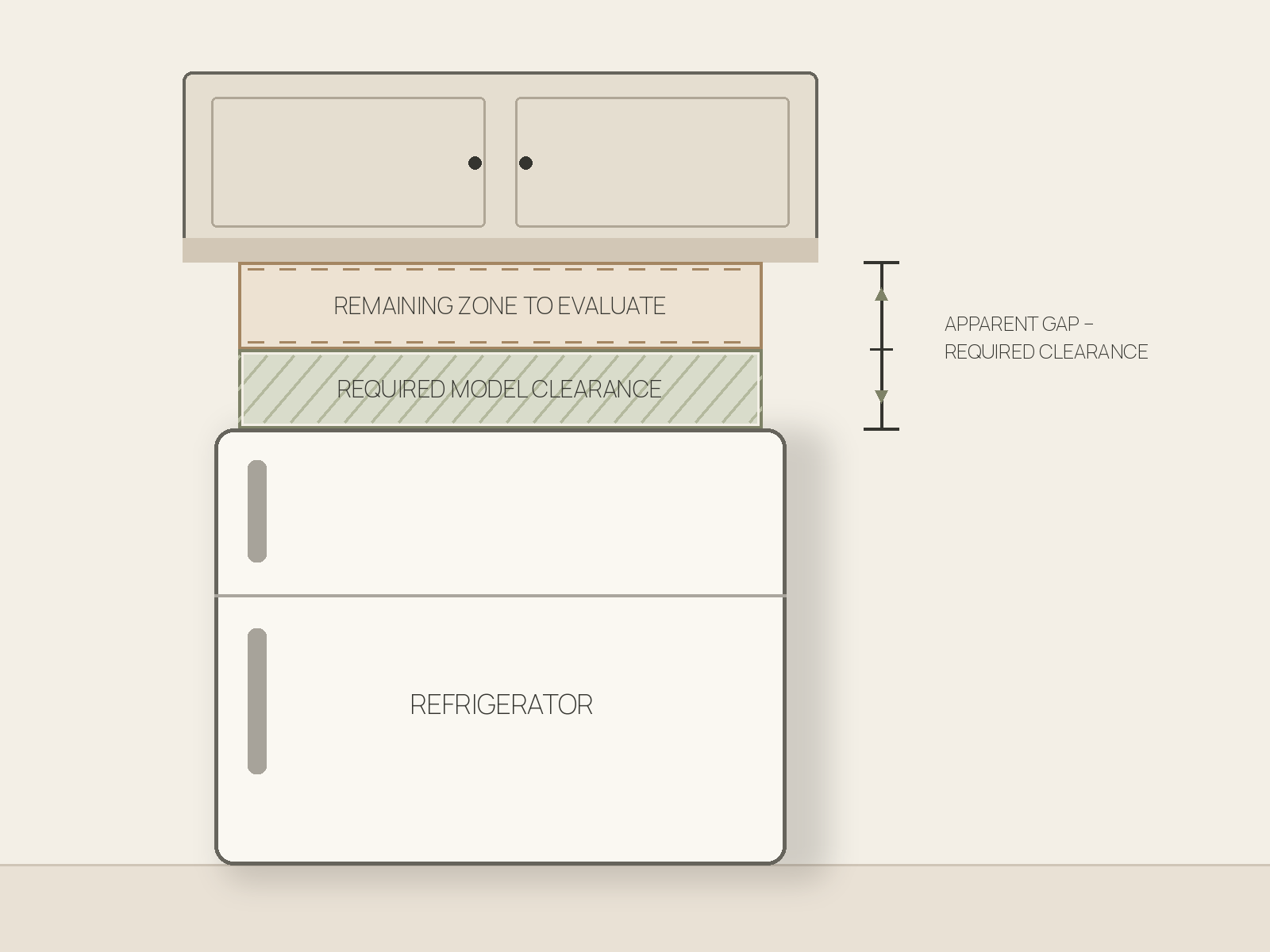
Treat required clearance as part of the refrigerator, not as empty storage space. Do not wedge bins, paper goods, fabric bags, or another shelf into a gap the manufacturer requires for installation or airflow.
The usable height is the space left after that requirement is removed from the apparent gap. Ceiling-to-fridge distance and usable storage height are not automatically the same measurement.
Keep service and cleaning access in the calculation too. A storage setup that makes the appliance difficult to inspect, clean, or move when required is consuming more than the visible footprint suggests.
03
Treat direct storage and upper cabinets differently
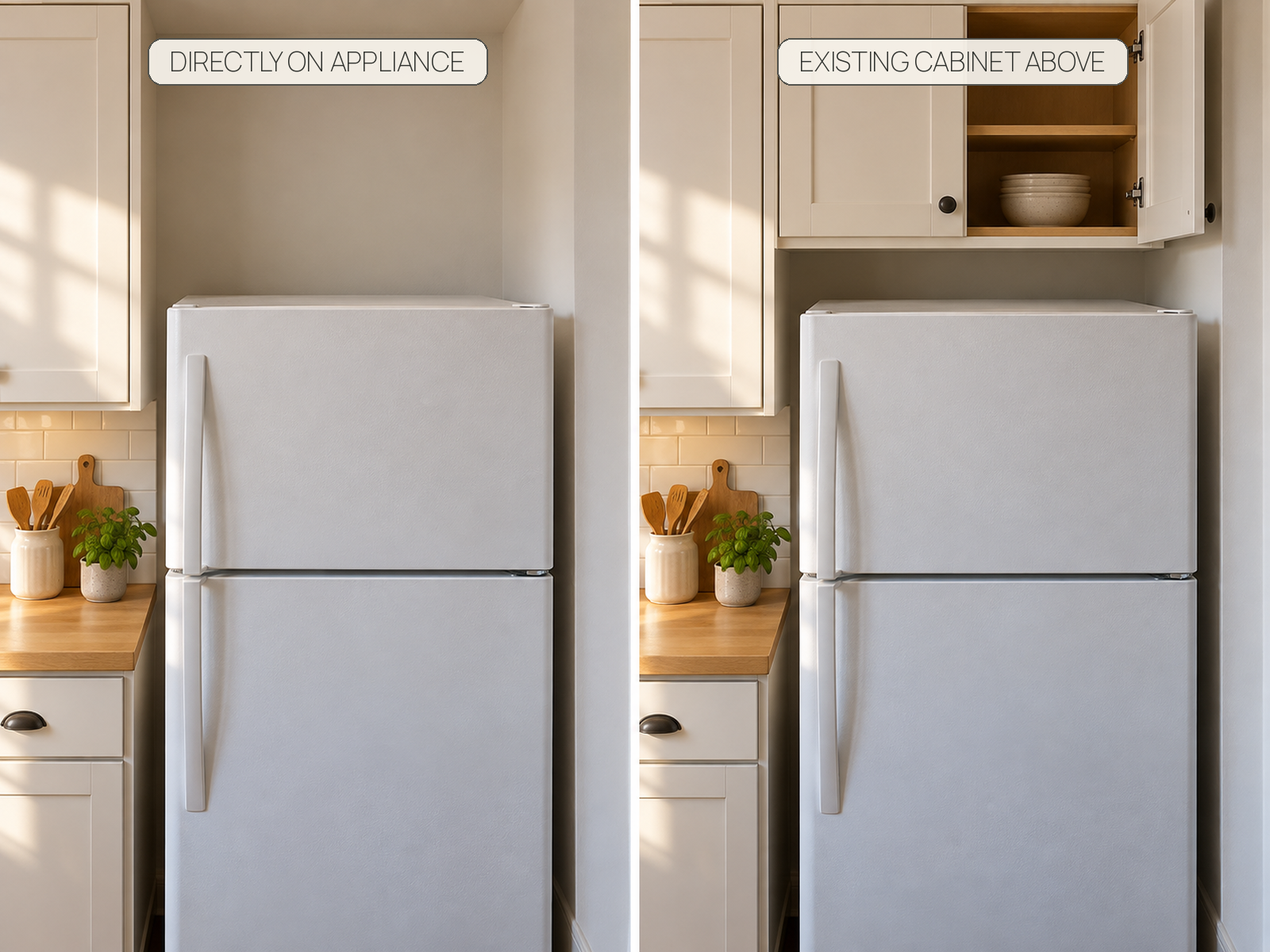
Putting an object directly on the refrigerator and using an existing cabinet above it are different conditions.
Direct-on-top storage has to satisfy the refrigerator’s own restrictions, ventilation path, door movement, cleaning needs, and item stability. Do not assume that a lightweight object is automatically permitted simply because it seems harmless.
An existing upper cabinet is separate from the appliance surface, but it still has to preserve the required air gap below it. It also creates a reach problem: the full depth of the refrigerator can make even the front of a high cabinet awkward to access.
A new shelf or deeper refrigerator cabinet is a different branch again. That is installation or cabinetry work, not a default renter storage hack, and it must preserve the exact appliance clearance.
04
Store for reach frequency, not just empty volume
If the exact setup permits storage, high zones are better suited to categories you use infrequently. Daily-use items become poor candidates when every retrieval requires reaching over a deep refrigerator or getting a step stool.
Potential low-frequency categories in an existing permitted upper cabinet can include lightweight seasonal serving pieces, entertaining supplies, or backup paper goods. The category still has to fit the cabinet and be easy to grasp securely.
Do not turn packaged food into a universal above-fridge recommendation. Food-label storage requirements and the actual appliance/environmental conditions control.
Use / Skip
Decide whether the apparent storage is real
Use
Use the zone only after every gate passes
Count it as storage when the exact refrigerator documentation permits the condition, required clearance stays open, the item is appropriate for high storage, and retrieval and cleaning are safe.
Skip
Leave it empty when one gate fails
Treat the useful capacity as zero when the manual prohibits top storage, the required air gap consumes the space, reach is unsafe, or the zone creates more clutter and maintenance friction than storage value.
05
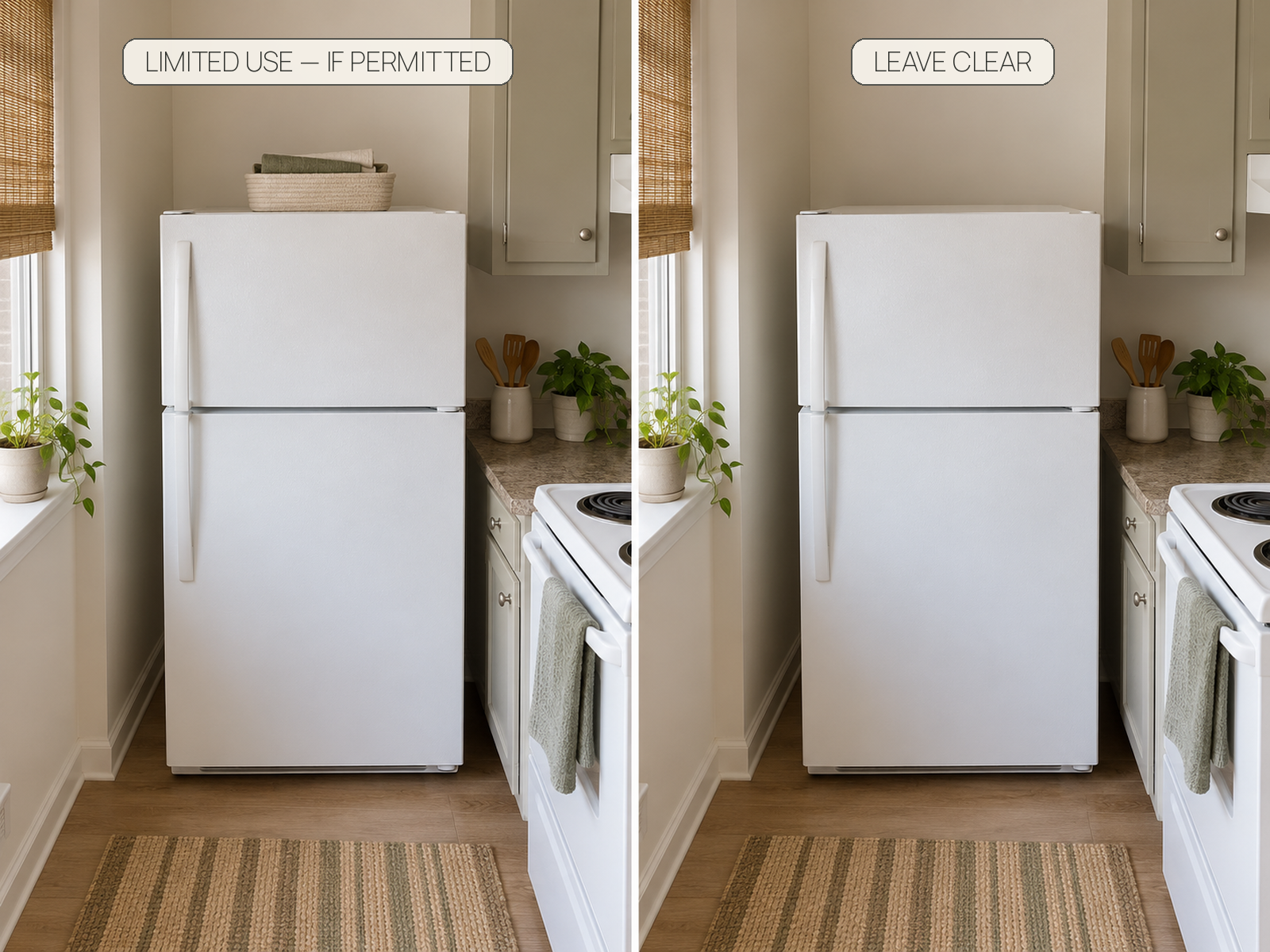
Keep direct-on-top storage light and limited when permitted
If the exact manufacturer documentation permits objects directly on the appliance, keep the category small and defined rather than treating the top as an open shelf.
Avoid heavy appliances as a generic solution. A microwave, air fryer, toaster oven, or other powered appliance adds separate questions about weight, heat, ventilation, power, reach, and the instructions for both appliances.
Liquids, breakables, unstable stacks, and hard-to-grip objects are also poor high-zone candidates. Some manufacturer documentation specifically warns that articles on top can fall when refrigerator doors open or close.
06
Know when to leave the top empty
An empty refrigerator top is not wasted space when the alternative compromises airflow, reach, cleaning, or visual order.
If a permitted upper cabinet is too difficult to reach for routine use, reserve it for genuinely low-frequency items or move the category elsewhere. If direct top storage is prohibited or awkward, use another cabinet zone, a legitimate rolling-cart location, pantry overflow, or backstock storage outside the kitchen.
Do not create storage that depends on standing on a chair, box, countertop, or other improvised surface. U.S. safety guidance recommends a stable step stool for high-reach tasks; that supports safer access but does not turn an otherwise unsuitable refrigerator-top zone into valid storage.
What Not to Do
Do not treat the refrigerator top as a free shelf
- Do not publish or follow one universal top-clearance number for every refrigerator.
- Do not store objects directly on top when the exact model documentation prohibits it.
- Do not fill required ventilation or installation clearance with bins, bags, paper goods, or shelving.
- Do not assume a microwave or other powered appliance is suitable on top simply because it physically fits.
- Do not use unstable, breakable, liquid-filled, or difficult-to-grip objects as default high storage.
- Do not stand on chairs, boxes, or countertops to reach the zone.
- Do not add permanent shelving or cabinetry in a rental without permission and appliance-clearance verification.
The useful rule is to subtract the appliance zone before counting the storage zone. If nothing safe and practical remains, leaving the top clear is the correct small-space decision.
RELATED GUIDES
What to Read Next
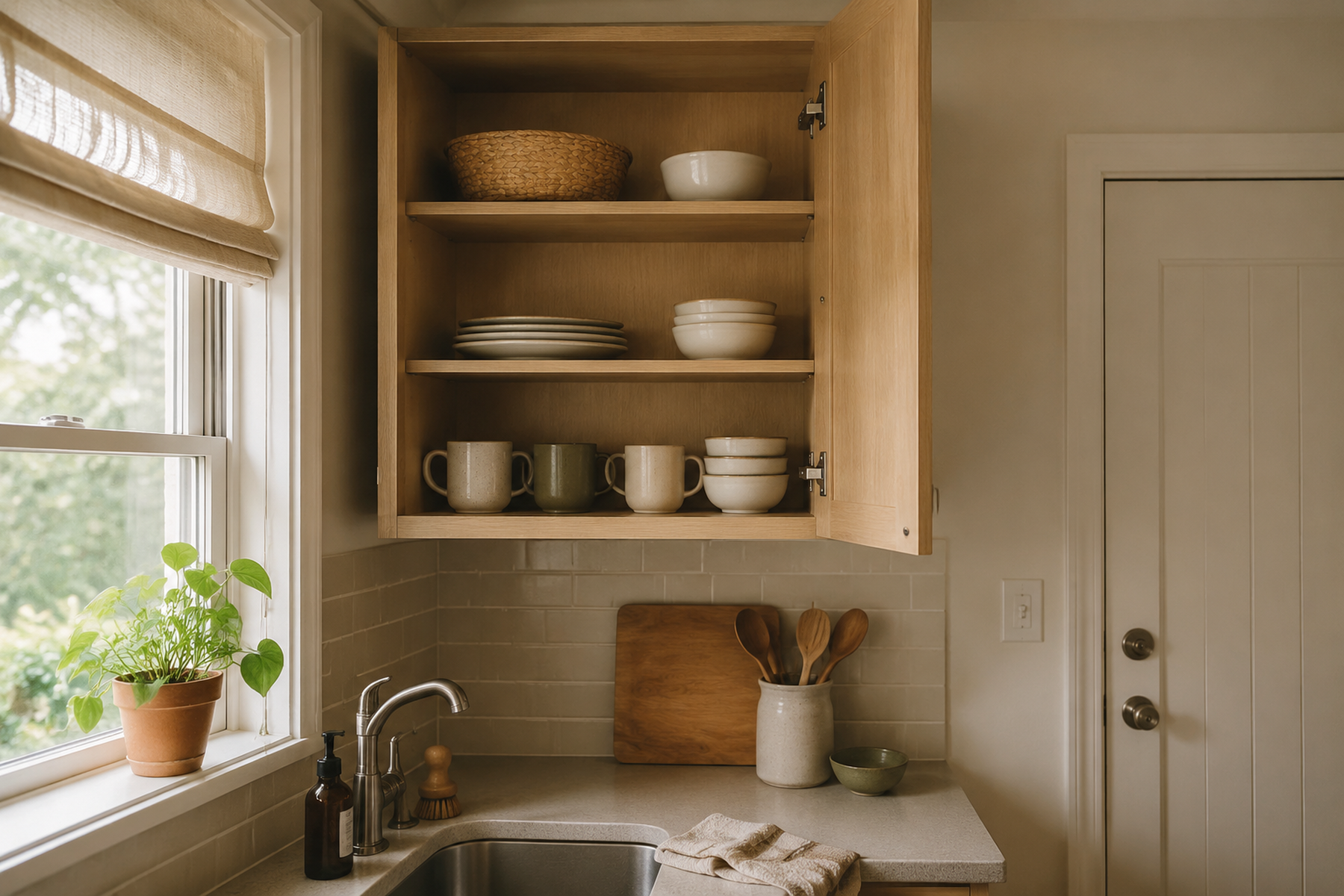
NEXT GUIDE
How to Organize High Kitchen Cabinets When Upper Shelves Are Hard to Reach
Use this when an existing above-fridge cabinet is technically available but its height and depth make retrieval the next problem.
GUIDE
What to Do When a Refrigerator Door Will Not Open Fully Next to a Wall
Read this for another refrigerator-specific geometry problem where the exact appliance operating requirements determine whether surrounding space is truly usable.
GUIDE
How to Use Fixed Kitchen Cabinet Shelves Without Wasting Vertical Space
This helps when the better answer is to reclaim capacity inside existing cabinetry instead of forcing storage onto the refrigerator top.