
Small Apartment Storage Ideas
How to Fit a Walking Pad in a Small Apartment Without Taking Over the Floor
Plan the walking pad as two objects—the machine while you are using it and the machine while you are storing it. Measure both states, account for move weight and retrieval friction, match the equipment to walking versus running, and treat downstairs-neighbor noise as a building-specific risk rather than something a “quiet” motor specification can guarantee.
In This Guide
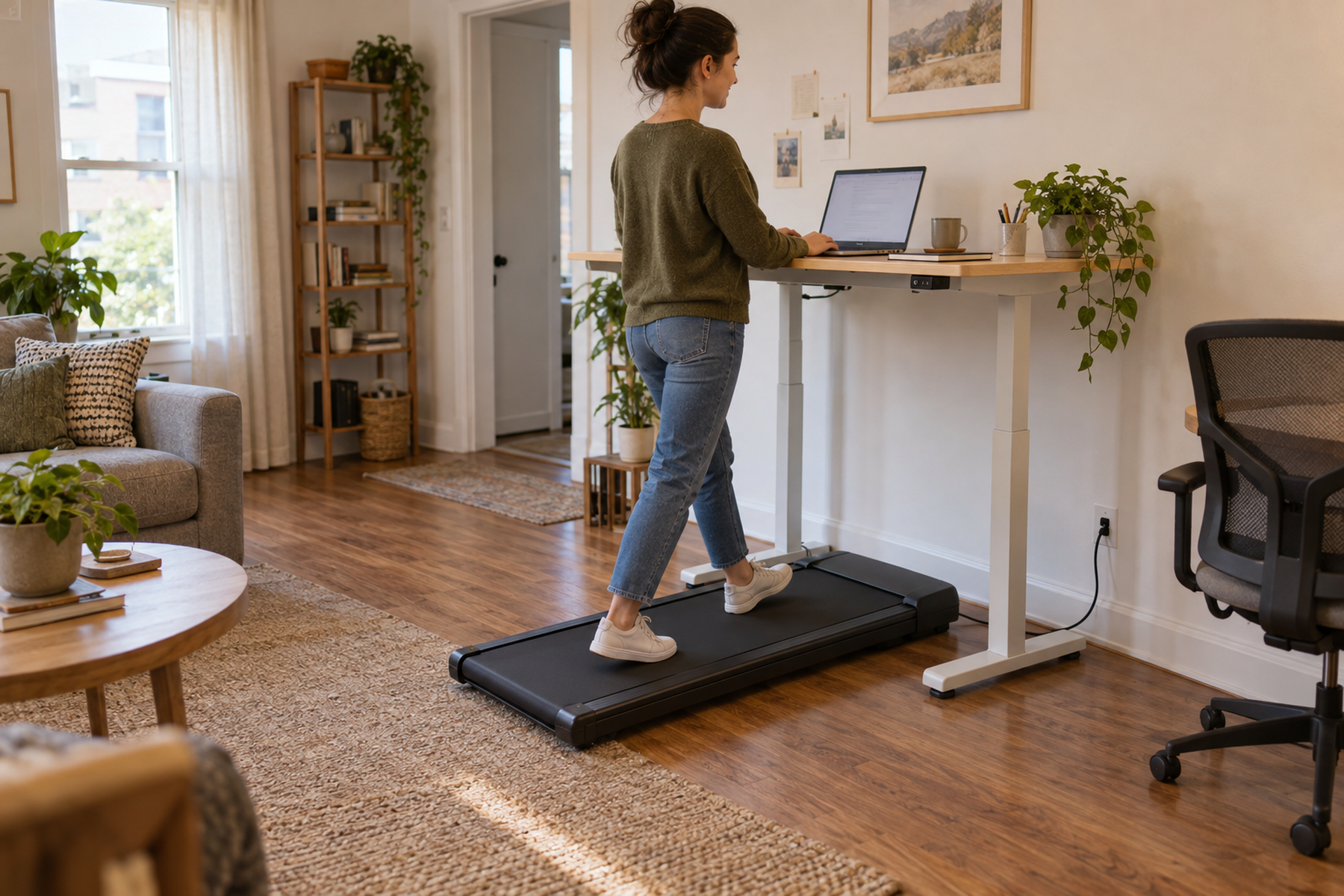
A walking pad can look like the perfect apartment exercise machine because it is thinner and easier to store than a traditional treadmill. But a machine that fits under a desk can still fail if it blocks the step-off path, weighs too much to move every day, will not clear the bed frame, or transmits repeated impact into the floor below.
The useful decision is whether the apartment supports the pad in both states: operating and stored. Start with the exercise you actually want to do, then measure the working zone, the storage opening, the retrieval path, the machine’s weight, the power route, maintenance access, and the noise risk for the building.
Quick Answer
Plan the Operating State and the Stored State Together
A walking pad is a strong small-space fit only when the apartment can support safe use, realistic storage, repeatable movement, and acceptable shared-building impact.
01
Choose walking equipment for walking
Many flat walking pads top out around 4 mph and have no fixed handrail. If the real goal is jogging or running, choose equipment designed for that use even if the running-capable machine is harder to store.
02
Measure four spaces, not one
Check the machine’s operating footprint, step-on/step-off envelope, stored footprint, and retrieval path. A folded dimension is not enough if the machine cannot clear the furniture opening or is too awkward to move.
03
Treat quiet claims as incomplete
A quiet motor does not tell you what the downstairs neighbor will hear or feel. Footfall, floor construction, speed, user gait, and the building all matter, so neighbor compatibility cannot be guaranteed from a product dB number.
01
Decide Whether You Need a Walking Pad or a Treadmill
Start with use class. A flat under-desk walking pad is designed around walking and compact storage, while a compact folding treadmill can add a handrail, safety key, taller deployed structure, and higher speed for jogging or running.
Current manufacturer examples show the difference. WalkingPad C2 and P1 models sit in the walking-speed class around 4 mph or below, while UREVO’s Foldi Mini adds a folding handrail, safety key, and speeds up to 6.2 mph.
Do not buy a walking-only pad because it stores more neatly if the intended workout is running. The storage advantage disappears if the equipment does not support the actual use.
The same logic works in the other direction. If the goal is light walking while working or watching television, a lower-profile walking pad can avoid the height and storage burden of a larger treadmill architecture.
02
Measure the Operating Zone, Not Just the Deck
Record the machine width and length, then add the space required to get on, walk, step off, reach the controls, and move around nearby furniture.
Under a standing desk, measure between the desk legs or base, not simply the desktop width. The walking pad raises the user above the floor, so the desk also needs enough height range to remain comfortable at the new standing level.
Keep the power route out of the walking path. The nearest outlet is not useful if the cord crosses a doorway, sits where the chair rolls, or forces the pad into a cramped position beside the desk.
Follow the exact manual for required clearances and step-off space. Do not push the rear roller tight against a wall or sofa just to recover a few inches unless the manufacturer explicitly permits that operating geometry.
Measure / Check First
Before choosing between a flat pad, fold-in-half pad, or compact treadmill, test the apartment against the machine in use and in storage.
Check the Operating Zone, Storage Slot, and Daily Move First
01
The active walking and step-off zone
Tape or map the machine footprint, desk or furniture conflict, step-on/step-off area, power route, and any model-specific clearances from the manual.
02
The real storage opening
Measure the lowest usable opening under the bed, sofa, desk, or cabinet, including center supports, crossbars, rug edges, and the angle needed to slide the machine into place.
03
The retrieval route and machine weight
Trace how the machine reaches the operating zone. Include door thresholds, furniture turns, transport wheels, lifting points, and whether moving roughly 35, 55, or 60-plus pounds is realistic at the frequency you expect.
If the machine fits only after moving furniture, lifting more weight than you want to handle daily, or threading the cord across circulation, choose a different storage architecture before buying.
03
Measure the Storage Opening and Retrieval Path
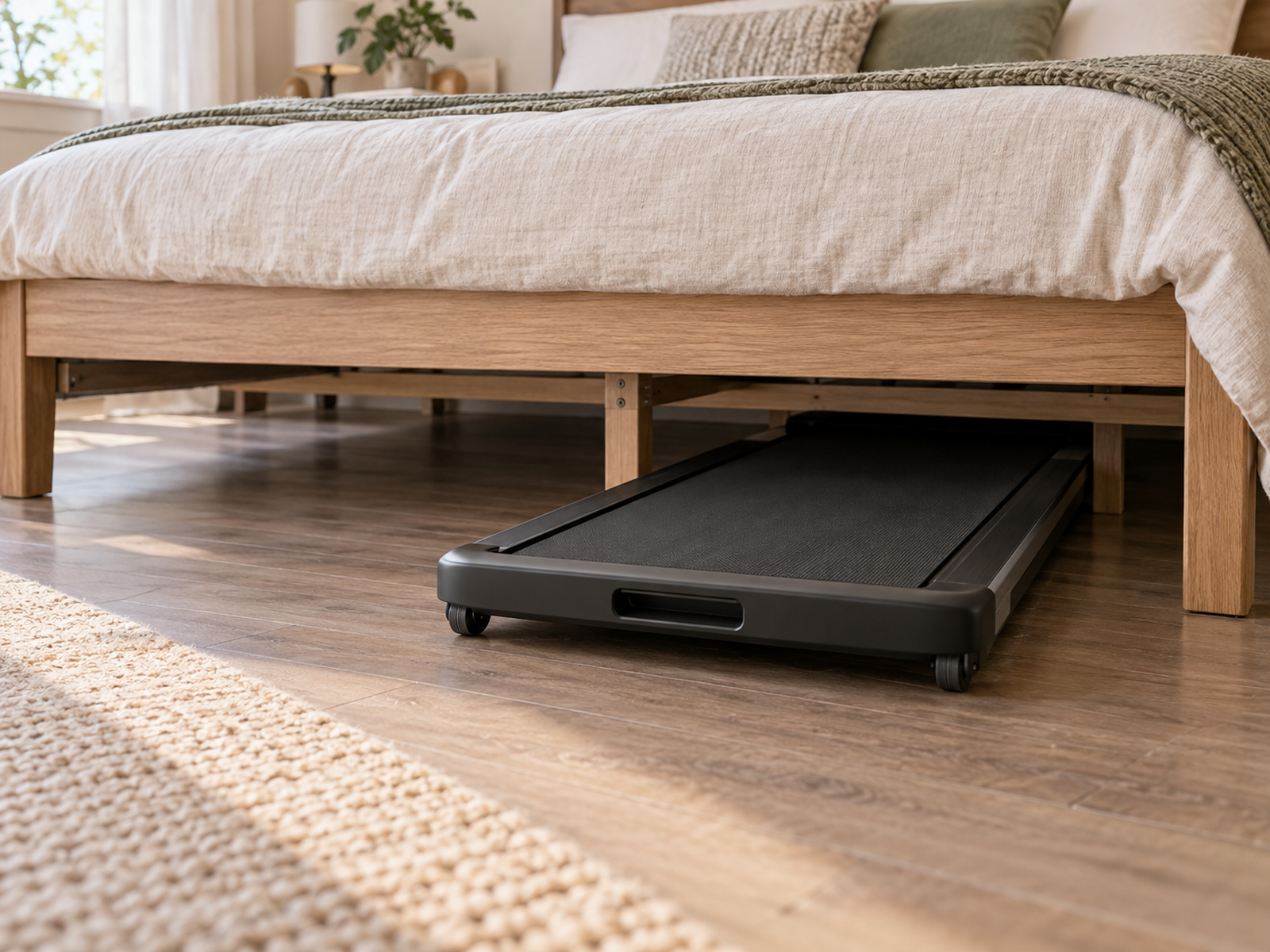
Under-bed and under-sofa storage only works when the machine fits through the actual opening, not the advertised furniture height.
A bed can have enough nominal clearance at the edge while a center support, low crossbar, storage bin, or rug prevents the pad from sliding fully underneath. Measure the narrowest point and the approach angle.
Flat pads trade shorter height for full-length storage. UREVO’s SpaceWalk E1L is about 42 inches long and roughly 4.2 inches high, so the user needs a long clear slot even though the machine is comparatively light at about 36.6 pounds.
Fold-in-half pads trade handling weight for shorter stored length. WalkingPad’s C2 and P1 fold to roughly 32.5 inches long, but current listed weights are about 55 and 62 pounds. A shorter object is not automatically the easier daily system.
04
Choose Flat or Fold-in-Half Storage Based on the Scarce Dimension
Choose a flat low-profile pad when the apartment has a long, shallow storage slot and the user values lighter daily movement more than minimum stored length.
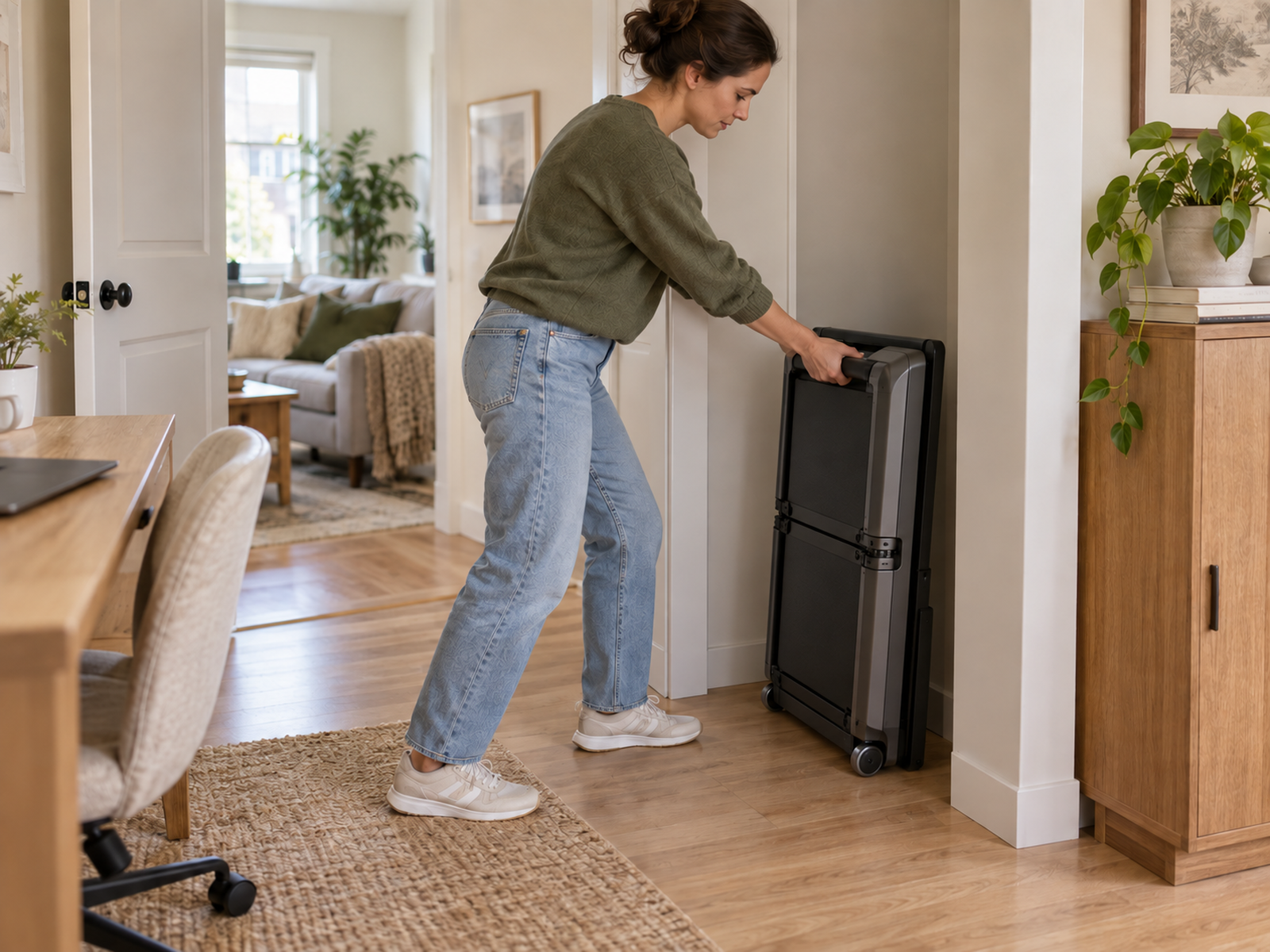
Choose a fold-in-half pad when storage length is the hard constraint. A machine that drops from roughly 56 inches to around 32.5 inches can fit a closet edge or furniture opening that a full-length pad cannot.
Do not compare folded length without comparing weight. A 55–62 pound folded machine may be compact enough for the room but unpleasant to lift, turn, or reposition every morning and evening.
Also verify storage orientation in the exact manual. Product photography may show a machine near a wall or under furniture, but that does not establish that every walking pad can be stored vertically or on its side.
Use / Skip
A Daily Fold-and-Store Routine
Use
Use it when shorter storage length solves a real constraint and the move is easy enough to repeat
A fold-in-half pad can work well when the apartment has no full-length storage slot, the folded dimensions clear the intended niche, the machine’s weight is manageable for the user, and folding or rolling it away after each session takes little enough effort that the routine will survive daily use.
Skip
Skip it when the machine is technically compact but too heavy or awkward to reset every day
A flat pad parked permanently under a standing desk, a lighter full-length pad, or no machine may be the better system when folding requires lifting 55–60-plus pounds, moving furniture, navigating tight turns, or handling the machine often enough that storage friction becomes the main obstacle to using it.
05
Decide Whether the Pad Should Stay Under the Desk
Permanent under-desk parking can be more space-efficient than repeated storage when the office zone is already dedicated to standing work and the walking pad does not block circulation.
This removes the daily lift-and-roll routine, but it changes the workstation. The desk needs enough height range for the raised standing position, and the chair needs a separate place when the pad occupies the floor below the desk.
Check the desk base as carefully as the pad. T-shaped legs, crossbars, floor feet, cable trays, and monitor-arm placement can all limit where the machine sits or how the user steps onto it.
If the desk is also a seated workstation, decide where the pad goes during seated work. A machine that permanently occupies the chair path simply moves the storage problem from one part of the room to another.
06
Treat Downstairs Noise as a Building-Level Constraint
Do not use a “quiet motor” claim as proof that the machine will be quiet for the apartment below.
What the downstairs neighbor experiences can include repeated footfall and structure-borne vibration in addition to the machine’s airborne motor noise. Floor construction, flooring material, user gait, walking speed, machine location, and the room below can all change the result.
That makes noise partly unknowable before real-world use. If the building is sensitive, check lease or building quiet-hour rules, use the pad during permitted daytime hours, and choose a room or floor zone that creates the least conflict when you have reliable information about what is below.
A mat may protect the floor or alter vibration, but this Research does not support a universal mat thickness or material that makes a walking pad “neighbor-safe.” Treat any padding as product- and floor-specific rather than a guaranteed acoustic fix.
07
Keep Power, Maintenance, and Product Safety in the Plan
Walking pads are powered machines with moving belts, so the storage zone should not make the cord, controls, or maintenance points inaccessible.
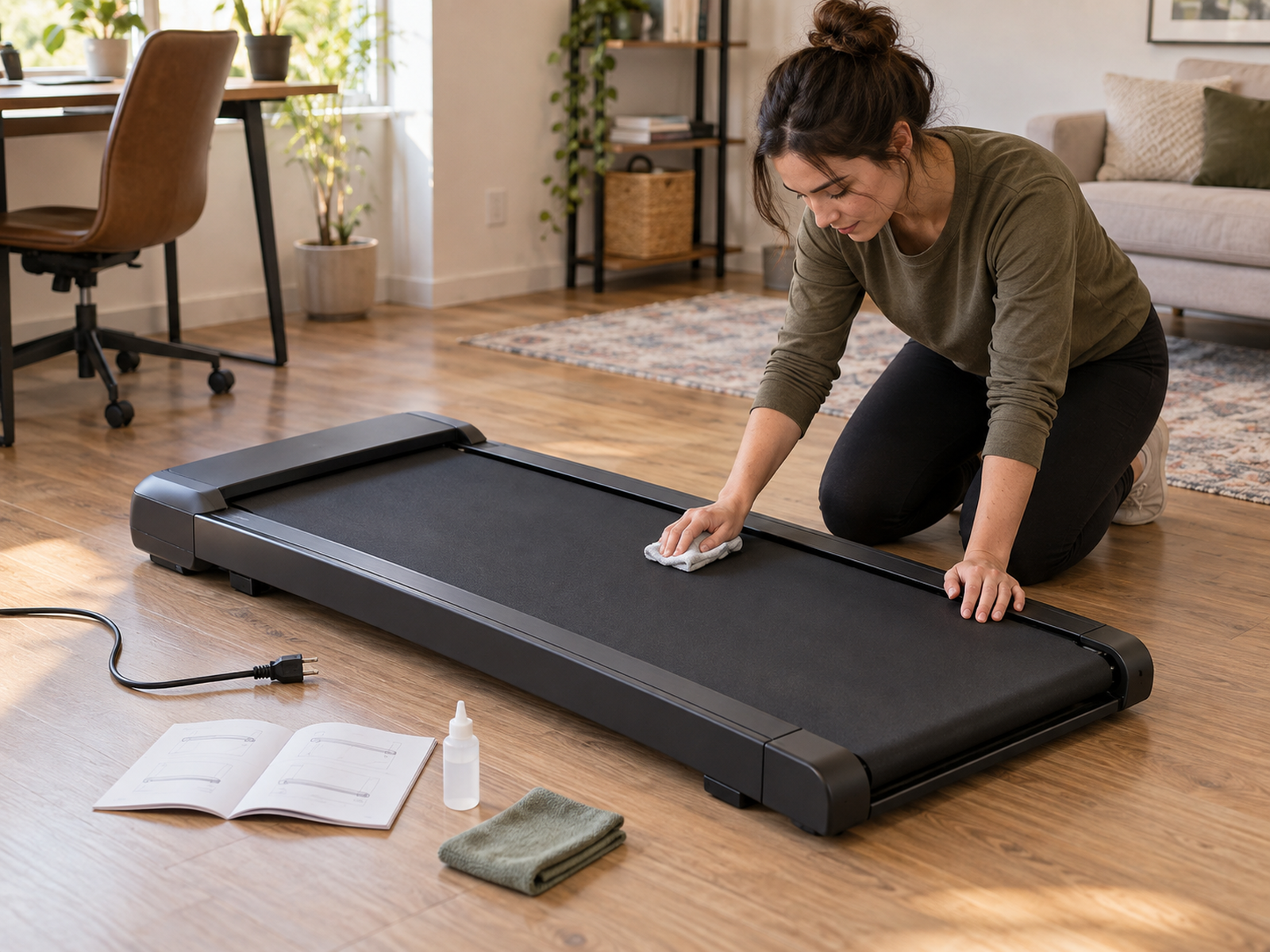
WalkingPad currently publishes belt-cleaning, lubrication, centering, and tension guidance across its walking-pad line, and UREVO provides model manuals and belt-adjustment/lubrication support. Exact intervals and procedures remain model-specific.
Store the machine where routine maintenance can actually happen. A pad jammed deep under furniture with no practical way to inspect or service the belt is not well stored simply because it disappears visually.
Before purchase—and again if a model is already in use—check the exact brand and model against current CPSC recalls and safety warnings. CPSC issued an April 16, 2026 stop-use warning for specific Sperax Pro, Q1, RM-01, and RM-02 walking pads/treadmills after reports involving speed changes, abrupt stops, falls, overheating, and fires.
08
Reject the Walking Pad When the Apartment Cannot Support the Routine
A walking pad is not automatically better than outdoor walking, a building gym, or another compact movement routine merely because it fits under furniture.
Reject the purchase when the machine does not match the desired use class, the operating zone is unsafe, the storage slot is unrealistic, daily movement is too heavy, the power route creates a trip hazard, or the exact model has an unresolved stop-use warning or recall.
Also reject it when neighbor impact is likely to create a persistent conflict that the household cannot test or manage. A motorized machine that makes the apartment stressful is not a small-space solution.
The best apartment system is the one that is practical enough to use and easy enough to live around. If that system does not include a walking pad, the feasibility check has still done its job.
Closing Decision
Choose the System You Can Operate, Store, and Live With
A strong walking-pad setup works in both states: the machine is safe and unobtrusive enough while operating, and it is genuinely manageable while stored. The retrieval path, machine weight, desk geometry, power, maintenance, and building-noise risk all count as part of the footprint.
Choose walking equipment for walking, measure the real storage opening, and treat neighbor noise and current safety status as unresolved risks to verify rather than marketing promises. If daily setup or building conflict costs more than the machine saves, use a simpler movement system instead.
RELATED GUIDES
What to Read Next
NEXT GUIDE
How to Store Workout Gear in a Small Apartment Without a Dedicated Workout Room
Use this next if the walking pad is only one part of a shared living-room exercise setup; that guide handles passive workout gear without duplicating the powered-equipment placement problem.
GUIDE
How to Work From a Dining Table Without Letting It Become a Permanent Office
Use this if the walking pad is part of a fold-away work setup in a shared room; that guide focuses on restoring the dining/work surface when the office cannot stay permanently deployed.
GUIDE
How to Set Up Dual Monitors on a Small Desk Without Losing Work Surface
Use this if the walking pad is being paired with a compact standing desk and the desktop itself is already constrained by monitor depth and equipment placement.